


Meet Your Military
- Details
- Hits: 3944
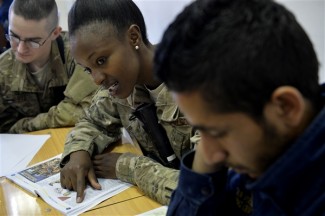 PHOTO: Air Force Staff Sgt. Linette Nosim teaches English to Afghan students at Bagram Airfield, Afghanistan, May 21, 2014. Nosim volunteers at the Korean Vocational Training Center to help the students improve their language skills. U.S. Air Force photo by Staff Sgt. Evelyn Chavez BAGRAM AIRFIELD, Afghanistan – Seventeen years ago, a Kenyan girl and her family embarked on a 7,000-mile journey to America, where they hoped for a better life, a better future and the opportunity to succeed. She did not speak English and had no idea what to expect from the country she later would call home. Despite the struggle to overcome the cultural and language barriers, the little girl persevered. Now deployed here, Air Force Staff Sgt. Linette Nosim helps others learn the language that once challenged her. "Everything was new to me. I grew up in a town with no running water," said Nosim, the 455th Expeditionary Logistics Readiness Squadron’s traffic management office receiving supervisor. "I cried myself to sleep sometimes, because it was a lot to take in, but even at a young age I knew I had to learn in order to succeed." Nosim moved to America at the age of 9, and she quickly learned how to speak English by reading, participating in summer school and watching television to help her hide her accent so other children wouldn't make fun of her. "The teachers were not patient with me," she said.
"I didn't want to hold the class up, so I stopped asking questions. I wanted to learn as much as I could. I knew I had to overcome the challenge somehow." Within a year, Nosim said, she adjusted and made progress at school. She moved through the education system, made new friends, and excelled in middle school and high school. After graduation, she joined the Air Force, and she experienced different countries and their cultures during deployments. Always an active volunteer, she said, she never had the opportunity to teach English until now. The Korean Vocational Training Center here allows her a chance to dedicate her time to the Afghan community. Afghan students learn the basics of the English language because of Nosim and other volunteers. She is one of about 40 volunteers who dedicate three hours once a week to help Afghan students become proficient in the language and to learn electrician, construction and welding trade skills.
Read more: Meet Your Military: Airman Teaches English to Afghans
- Details
- Hits: 3379
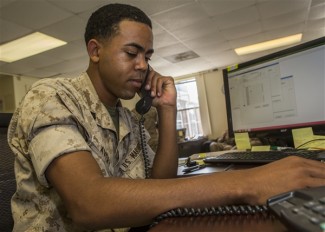 PHOTO: Marine Corps Cpl. Marque L. Avery at the unit's command post at Camp Lejeune, N.C., June 5, 2014. U.S. Marine Corps photo by Lance Cpl. Joshua W. Brown CAMP LEJEUNE, N.C. – Marine Corps Cpl. Marque Avery recalls making the choice to join the military when he was in second grade. The Cleveland native said he contemplated joining the Army while he was in high school but opted to join the Marine Corps instead when he learned the Marine recruiter could make his dream come true sooner. “The Marine recruiter got me to boot camp faster and even arranged for me to leave for boot camp a month earlier than he originally planned,” the supply clerk assigned to the 26th Marine Expeditionary Unit said. For military prospects and those in the Delayed Entry Program, the opportunity to get to boot camp sooner can be beneficial.
The sooner they get through boot camp or basic training, the quicker they can get into the operating forces and begin their lives as service members. Avery said leaving sooner was more beneficial to his long-term plans, and that he was happy with the opportunity to be a Marine, because his father was one. “My dad was in the infantry and served for eight years,” he said. “My mom was supportive of my decision to join, because she knew how it was for my dad.” With the support of his mom, two older sisters, his younger brother and his grandparents, Avery enlisted and became a supply clerk. He deployed with the 26th MEU in 2013 as part of the unit’s rotational deployment to the U.S. 5th and 6th Fleet areas of operation. Avery is in his last month of active duty service and will transfer into inactive reserve status June 30. “When I’m out, I’m planning on going to Cleveland State and getting my degree in mechanical engineering,” he said. “I’ve always liked taking things apart and learning how they work, so that’s what I want to do.” The occupational skills Avery learned in the Marine Corps do not transfer directly to mechanical engineering, Avery acknowledged, but he said he learned other character and personal traits that will help him succeed. “Respect is the most important thing I’ve learned,” he said. “It isn’t about age or where you’re from.
Read more: Meet Your Military: Marine Hopes for Future in Engineering
- Details
- Hits: 3692
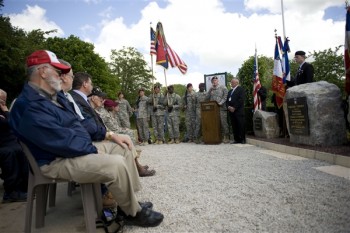 PHOTO: Army Col. Trevor J. Bredenkamp, commander of 1st Brigade Combat Team, 82nd Airborne Division, speaks at a ceremony in Amfreville, France, June 4, 2014, commemorating U.S. Army Lt. Col. Charles J. Timmes, the commander of 2nd Battalion, 507th Parachute Infantry Regiment, 82nd Airborne Division. U.S. Army Photo by Sgt. Daniel Cole AMFREVILLE, France – Army Lt. Col. Charles J. Timmes, the commander of 2nd Battalion, 507th Parachute Infantry Regiment, 82nd Airborne Division during the D-Day landings on June 6, 1944, parachuted into Normandy with his troops not knowing what the next 96 hours would bring. Upon landing, Timmes was immediately fighting for his life but not because of a German attack. Timmes had landed in a flooded field and nearly drowned when a strong wind gust filled his chute and dragged him over 200 yards.
Then, a second gust picked him up and dragged him onto a nearby hill, saving his life. Timmes and his command assembled more than a mile away from their original landing point where they came under attack from enemy forces. Timmes had 150 men, one 57-milimeter artillery piece, two machine guns and no means of communication with higher headquarters. German troops kept up pressure on the U.S. paratroopers, but Timmes and his men kept them at bay during four grueling days of combat. Finally, 1st Lt. John Marr from Golf Company, 507th PIR and Pfc. Norman Carter, the company’s runner, broke from the battle to make contact with the 82nd Airborne’s command post which was several miles away.
Upon arriving safely to the command post, Marr and Carter were able to inform the command of their situation. The 325th Glider Infantry Regiment then came to the rescue and attacked the German forces from behind, resulting in the enemy being overpowered and Timmes’ U.S. paratroopers winning the fight. Seventy years later, Timmes and his story are legendary in these parts. The place he landed is now known as Timmes’ Orchard and a memorial site rests nearby to remind the locals of the brave commander who led his troops through those fateful and seemingly endless nights. The memorial is made up of three standing stones, one each for the 507th PIR, the 508th PIR and the 325th GIR. On June 4, a gathering was held there in honor of Timmes and his fellow U.S. veterans, one of several commemorations this week celebrating the 70th Anniversary of D-Day.
Read more: Meet Your Military: French Citizens Honor American Hero
- Details
- Hits: 4095
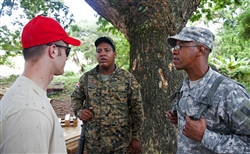 PHOTO: Army Sgt. Richard Mercedes interprets a conversation between Air Force Senior Airman Michael Hyer of the Ohio Air National Guard's 200th Red Horse Civil Engineering Squadron and Cpl. Ramon Burgos of the Dominican Republic’s army at an elementary school in La Guazara, Dominican Republic, June 2, 2014. U.S. Army photo by Sgt. Aaron Rognstad BARAHONA, Dominican Republic – For Sgt. Richard Mercedes of the Puerto Rico Army National Guard, annual training in the Dominican Republic means a little something more this spring. He's come back “home.” Mercedes, a civil engineer with the 190th Forward Support Company, spent the first 18 years of his life in the Dominican Republic before moving to Puerto Rico with his family. “There's a lot of emotion,” said Mercedes, who talks in a thick Caribbean Spanish accent. “To be working with the people and be part of the team that is helping them feels good.” Mercedes stepped out of his traditional job in the to serve as a translator for his annual training, which consists of various construction projects being built by Army and Air Force engineers. Escorting his fellow soldiers and airmen to job sites surrounding the Air National Guard, Army Reserve and National Guard base of operations here, Mercedes is a vital link in bridging the language barrier and serving as a guide and subject-matter expert on the surrounding countryside. “I'm sure I'll be very busy over these next few weeks -- lots of translating and going here and there,” he said. “Whatever they need, I'm just here to help and make things less difficult.”
Read more: Meet Your Military: Deployment Takes Soldier to Original Home
- Details
- Hits: 3565
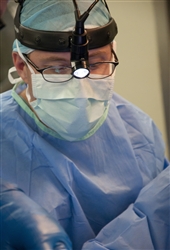 PHOTO: Air Force Maj. (Dr.) Forrest Jellison, a urologist, works with his surgery team during a penectomy, May 27, 2014, at the Karl Heusner Memorial Hospital in Belize City, Belize. An Air Force surgical team deployed to Belize for two weeks during a New Horizons Belize 2014 surgical readiness training exercise. U.S. Air Force photo by Tech. Sgt. Kali L. Gradishar BELIZE CITY, Belize– Deployed in support of New Horizons Belize 2014, a multifaceted exercise providing training opportunities for Belizean and U.S. medical professionals, Air Force Maj. (Dr.) Forrest Jellison is finding ways to give back. "I've always wanted to give back in some way, because I know I'm fortunate for what I have," the urologist said. "I believe you have to give back to be able to have something worthwhile." Following a number of family members into the military, Jellison said, he considered enlisting before deciding on a career path that would take him to places he never anticipated going in uniform.
He graduation from Pacific Union College in Napa Valley, California, and followed his undergraduate education with medical school at Loma Linda University Medical Center in California, where he also completed his residency. Jellison then completed a urology fellowship at the University of California, Los Angeles. He was commissioned in 2001. After years of schooling, learning, teaching and traveling, Jellison deployed in support of New Horizons. Along with a urology and surgery team, he provided some life-saving surgeries with the assistance and coordination of the nation's sole urologist and other staff at the Karl Heusner Memorial Hospital here. "I'm very fortunate that this is part of my job," Jellison said. "This is something that I do and want to continue doing outside of where I'm tasked to go in the military."
Read more: Meet Your Military: Air Force Doctor Finds Ways to Give Back