


- Details
- Hits: 1971
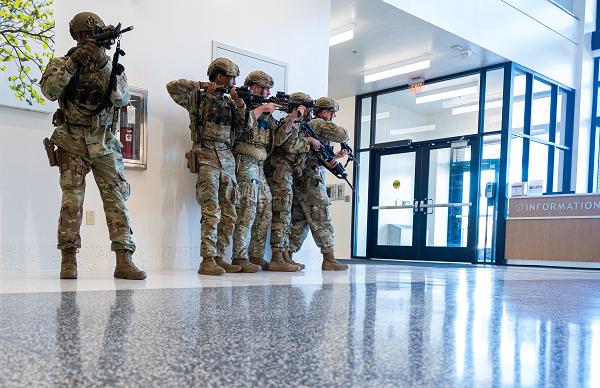
Joint Base Langley-Eustis, Virginia. (April 17, 2025): Active Shooter! In this photo by Senior Airman Mikaela Smith, Airmen from the 633rd Security Forces Squadron clear the lower level of a hospital during an active shooter training exercise. Unfortunately, active shooters have become all too common in American society. For the military, the prospect of active shooters on base is all too real.
Since 1993, US military installations have had more than twenty mass shootings. The most recent, and most deadly, was November 5, 2009, at Fort Hood, Texas. Major Nidal Malik Hasan, an Army psychiatrist, opened fire inside the base’s processing center, killing thirteen people and an unborn child, and wounding thirty-two others. Hasan was later sentenced to death and is currently on military death row at Fort Leavenworth in Kansas.
- Details
- Hits: 3491
“If a man says he isn’t afraid of dying, he is either a liar or a Gurkha.”
— Sam Manekshaw.
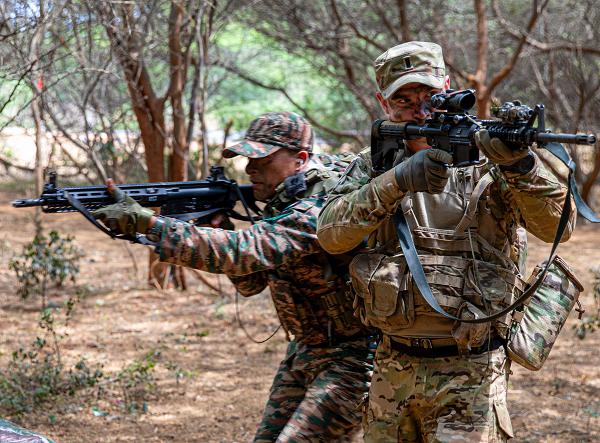
Visakhapatnam, India. (April 13, 2025): In this photo by 1st Sergeant James Tomlinson, a Soldier assigned to Bayonet Company, 1st Battalion, 5th Infantry Regiment, 1st Infantry Brigade Combat Team, 11th Airborne Division, provides cover for an Indian Army Gurkha rifleman. The Gurkhas are natives of Nepal with a fearsome reputation for effectiveness in combat. The Americans were in India participating in this year’s Tiger Triumph exercises.
The British Army “discovered” these fierce fighters early in the 19th century and hired them to protect its interests in neighboring India. During the Indian Rebellion of 1857, Gurkhas fought on the British side where they were officially became known as the Gurkha Rifles.
- Details
- Hits: 1616
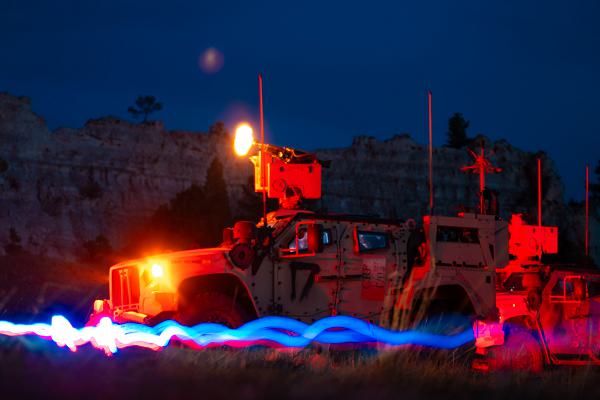
Camp Guernsey, Wyoming. (April 16, 2025): It is the ultimate nightmare scenario. An enemy force of considerable size and capability attacks a convoy of U.S. vehicles transporting a nuclear weapon. In this photo by Staff Sergeant Michael A. Richmond, Soldiers assigned to the 101st Airborne Division act as the opposing force to test the Air Force’s ability to guard these extremely sensitive convoys.
In its Nuclear Convoy Course, the Air Force uses paratroopers to simulate sophisticated attacks on base security. These series of attacks are used to evaluate how well America’s nuclear sites are protected. The goal is for students to identify gaps in their own defenses, make adjustments, and return to their home base prepared for any contingency.
Squaring off against the paratroopers was the 90th, 91st, and 341st Missile Security Operations Squadrons from F.E. Warren Air Force Base, Wyoming; Minot AFB, North Dakota; and Malmstrom AFB, Montana, respectively.
- Details
- Hits: 2020
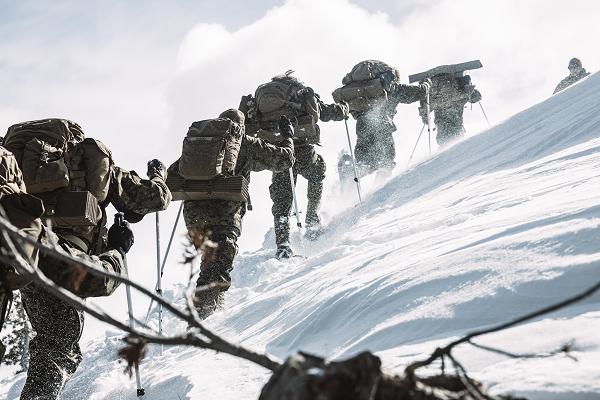
Bridgeport, California. (April 26, 2025): To most of us, scaling a mountain in a driving snowstorm would be an ordeal. To the Marines, it is the perfect place to take a hike. In this photo by Sergeant Mary Torres, Marines and Sailors with Combat Logistics Battalion 6, Combat Logistics Regiment 2, 2nd Marine Logistics Group, and 1st Battalion, 6th Marine Regiment, 2d Marine Division, take part in a tactical exercise during Mountain Training Exercise 2-25 at the Marine Corps Mountain Warfare Training Center.
The Mountain Warfare Training Center is used to prepare Marines and allied forces to operate in mountainous, high altitude, and freezing weather environments. The Center was established in the 1950s to season troops in freezing weather before they deployed to fight in the frozen mountains of Korea.
- Details
- Hits: 1967
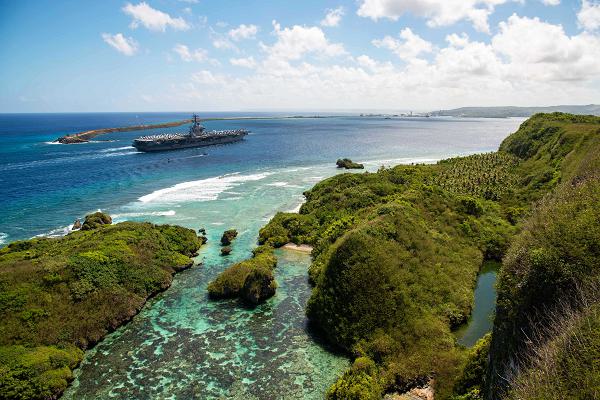
Apra Harbor, Guam. (April 18, 2025): The beautiful island of Guam looks down upon the world’s most famous aircraft carrier, the USS Nimitz. In this photo by Petty Officer 1st Class Samantha Jetzer, the USS Nimitz arrives for a scheduled port visit and to commemorate Admiral Chester Nimitz and his contributions to liberating Guam.
During World War II, Admiral Chester W. Nimitz was Commander in Chief of the U.S. Pacific Fleet, and he played a crucial role in the recapture of Guam. Then a U.S. territory, Guam was invaded by the Japanese on December 10, 1941, which began a thirty-two-month ordeal for the island’s inhabitants, the Chamorros. Japanese troops routinely used forced labor, beatings, and torture to subdue local tribes. Those suspected of helping Americans were often beaten, tortured, and killed. The brave islanders endured this harsh treatment until rescued by American forces.
- Details
- Hits: 1805
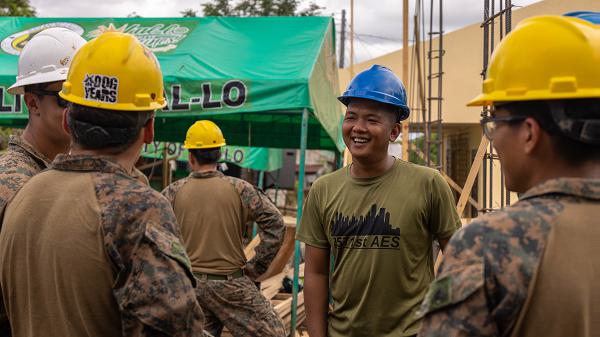
Lal-lo, Cagayan, Philippines. (April 11, 2025): American and Filipino forces staged a “full-scale battle scenario” this week as part of Exercise Balikatan 25, an annual military exercise. In this photo by Lance Corporal Roger-Junior Annoh, Philippine Air Force A2C Melvin Mendoza, an engineer with the 357th Air Engineering Squadron, laughs alongside U.S. Marine Corps combat engineers assigned to Marine Wing Support Squadron 174, Marine Aircraft Group 24, 1st Marine Aircraft Wing, at a local construction site. While these engineers labored on civic relations projects, thousands of American and Filipino forces conducted combat drills that included repelling a simulated attack against the island.
Based at Kaneohe Bay, Hawaii, Marine Wing Support Squadron 174 is an aviation ground support unit that is part of the 9,000 U.S. military participating in the exercises which run through May 9th. Over 5,000 Filipino troops will join the Americans in conducting mock counter assaults against an enemy attack on the island including using a barrage of artillery and missiles to sink an enemy ship. The U.S. will deploy its new anti-ship missile system, called the Navy Marine Expeditionary Ship Interdiction System, as well as a series of unmanned sea vessels. Throughout the exercises, U.S. and Philippine forces will conduct joint patrols in the disputed South China Sea to assert international law and freedom of navigation.