


- Details
- Hits: 1329
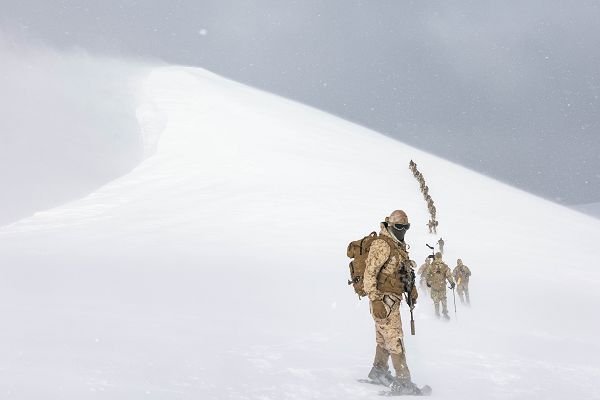
Punta Arenas, Chile.(September 21, 2023): In this photo by Sergeant Cameron Hermanet, U.S. Marines with 1st Battalion, 4th Marine Regiment, 1st Marine Division, and members of the Chilean naval infantry climb Mount Tarn for the culminating event of a bilateral freezing weather training exercise. Throughout the maneuver, Marines learned proper techniques for obtaining food and water, employed different weapons and gear, built shelters, practiced foot movements over snow, and conducted wintry weather personnel rescue. Training exchanges in South America provide U.S. forces opportunities to train in exotic environments such as humid jungles, frigid mountains, and complex waterways while strengthening partnership and enhancing overall interoperability with regional partners.
Chile is one of the United States' strongest partners in Latin America and a leader in promoting respect for the rule of law, economic stability, education, environmental protection, human rights, and sustainable development.
Regarded as one of the least corrupt and most vibrant democracies in South America, with a healthy economy, Chile is noted as being one of the closest strategic allies of the United States in the Southern Hemisphere, along with Colombia, and remains part of the Inter-American Treaty of Reciprocal Assistance.
The Chilean Marine Corps consists mainly of an amphibious assault force, a coastal defense force, special forces, and support garrisons. The Chilean Marines provide artillery and coastal defense, with batteries of howitzers and Excalibur missiles, and they protect the country’s naval facilities. They also specialize in bomb disposal as part of their international responsibilities.
- Details
- Hits: 3011
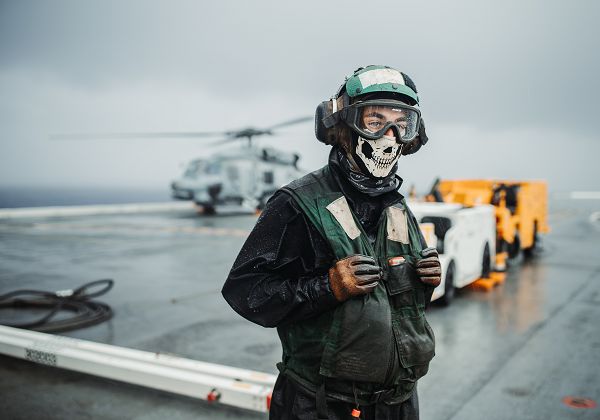
Atlantic Ocean.(September 21, 2023): Working on a busy flight deck is one of the most dangerous jobs on earth, and these guys wouldn’t have it any other way. In this photo by MC1 Seaman August Clawson, Aviation Boatswain's Mate (Launching and Recovery) Airman Apprentice Ryan Bowden, assigned to Air Department V2 Division, stands by to recover aircraft during flight operations aboard the Nimitz-class aircraft carrier USS George Washington.
Imagine the scene on the flight deck of an aircraft carrier at sea. This 300-foot runway is packed with incoming and outgoing aircraft taking off and landing in all climates, day, and night. The noise created by jet engines and helicopter rotors is so deafening. Sailors must communicate through hand signals. Danger is everywhere on the flight deck as bombs and missiles are transported to waiting fighters while other planes are taxiing to the launch catapults or to their parking locations. The slightest mistake and a Sailor can be blown off the deck or sucked into one of the planes jet engines.
To work in this “controlled chaos,” Seamen must be in excellent physical and mental condition and be cool in extremely stressful situations. Despite the dangers, Aviation Boatswain's Mates seem to enjoy the adrenalin rush of this chaotic work environment.
To become a Navy Launching and Recovery Boatswain’s Mate, candidates attend Class A Technical School in Pensacola, Florida after passing basic training. This five-week course trains Sailors to operate, maintain, and perform maintenance on steam catapults, barricades, arresting gear, and associated equipment. Students learn how to operate catapult hydraulic systems, retraction engines, water brakes, jet blast deflectors, and arresting gear engines. They are also taught the necessary aircraft handling duties related to the operation of aircraft launching and recovery equipment.
Read more: Sailors Thrive In The “Controlled Chaos” Of A Carrier Flight Deck
- Details
- Hits: 1101
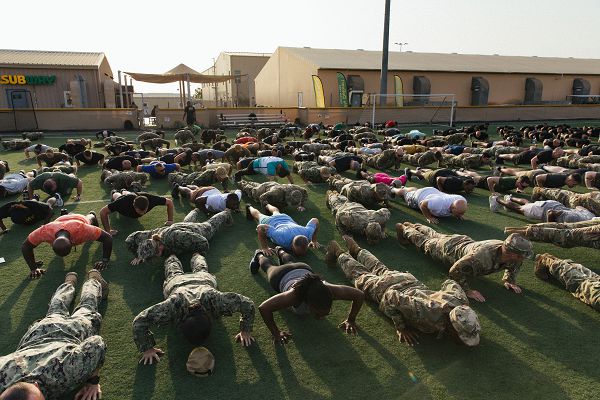
Camp Lemonnier, Djibouti. (September 13, 2023): It is a heartbreaking reality. Suicide rates among active-duty military members are at an all-time high since 911 and have been increasing over the past five years at an alarming pace. In fact, some branches of the Armed Forces are experiencing the highest rate of suicides since before World War II. In this photo by Air Traffic Controller 2nd Class Nicholas Renard, servicemembers participate in Camp Lemonnier's Suicide Prevention Awareness Month activity, a 22 Push-Up Challenge to highlight the problem and to stop this senseless loss of precious life.
According to the Department of Defense, 519 servicemembers died by suicide in 2021 with young, enlisted male servicemembers at greatest risk. The Annual Report shows that the suicide rates for Active Component Service members have gradually increased since 2011 and that 202 dependents also died by suicide during this same period. The Army experienced the highest increase in suicides, losing forty-nine servicemembers in the first three months of 2023, compared to 37 a year ago.
Why are our servicemembers suffering such high suicide rates compared to civilians?
- Details
- Hits: 8054
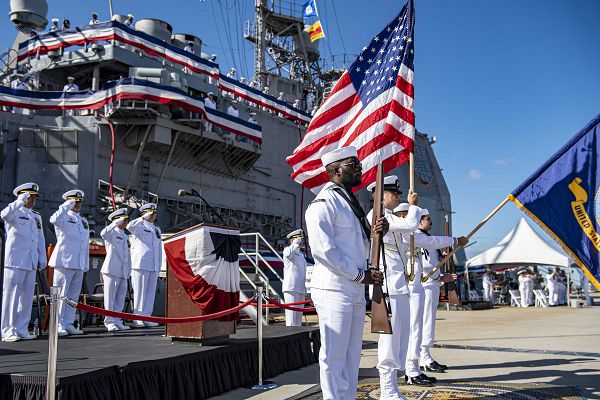
Norfolk, Virginia. (Sept. 15, 2023): Is there an old folk’s home for retiring Navy ships? Well… sort of. In this photo by CC2 Matthew Nass, Sailors render honors as the national anthem is played during the decommissioning ceremony of the guided-missile cruiser USS San Jacinto after more than 35 years of service.
The life cycle of a US Navy ship begins when its keel is laid down for construction. After construction is completed, the ship is launched on a shakedown cruise to evaluate crew performance at sea. Finally, when a vessel is deemed ready, the ship is commissioned into service, becoming an official part of the United States Armed Forces.
The USS San Jacinto was laid down on 24 July 1985, by Ingalls Shipbuilding, in Pascagoula, Mississippi and was launched in November 1986. Two years later, the ship was commissioned by then vice-president George H. W. Bush in Houston, Texas.
When its services are no longer needed, what happens, exactly, at that point?
Retiring or “decommissioning” Navy ships is a lengthy process that involves multiple phases before a vessel is put in mothballs. Before being officially decommissioned, the ship enters a “cool down” period at a naval facility where crews will remove usable parts. Next, weapons and ammunition are removed from a decommissioned ship and transferred to a different vessel as needed. The same happens with the crew which is reassigned to other ships in order of a crewmember’s duty. A gunner, for instance, would not remain on a ship after the guns have been removed.
When a ship is struck from the Naval Vessel Register, the name (but not her hull designation) is freed up for use on a future ship. Names are often reused as ships are commissioned and decommissioned before their final retirement. The battleship Missouri, for instance, was in service on and off from 1944 to 1992 until its final retirement.
- Details
- Hits: 2360
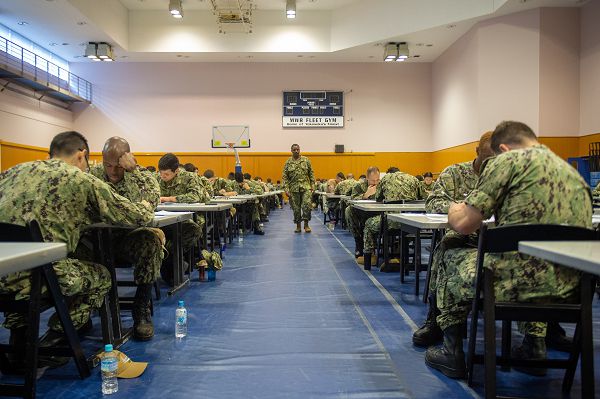
Yokosuka, Japan. (Sept. 14, 2023): In this photo by Seaman Kyree Rogers, Senior Chief Aviation Ordnance specialist Cody Shaw, from Kingstree, South Carolina, proctors as Sailors take the Navy-wide Advancement Exam (NWAE), a key step to eventual promotion. These sailors are assigned to the Ronald Reagan, the flagship of Carrier Strike Group 5 operating in the Indo-Pacific region.
For enlisted Sailors, advancement in the ranks is in part determined by how high they score on the NWAE. Given twice a year, the NWAE consists of 175 total questions concerning a Sailor’s occupational rating and is used as an unbiased measure to rank qualified candidates for advancement.
There are two windows throughout the year to take the NWAE; Spring and Fall for E4 to E6 candidates, and January/February for Chief candidates.
- Details
- Hits: 2777
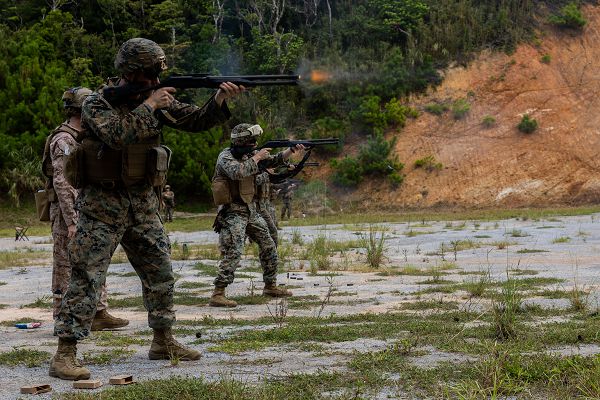
Camp Hansen, Okinawa, Japan. (September 7, 2023): In this photo by Corporal Kyle Chan, Marines with Marine Air Support Squadron 2, 1st Marine Aircraft Wing, fire their M1014 shotguns during a live fire exercise to increase their proficiency in area security.
It is likely these Marines toted their first shotgun as youngsters, playing the big game hunter, bagging their first quail. This national affection for the dependable twelve gauge is confirmed in a report by the Federal Institute for Justice that estimates forty-nine million Americans have shotguns in their homes. This familiarity naturally led to their use by America’s military and the weapon continues to play a critical role in combat to this day.
Today’s high-tech shotguns trace their roots to the Blunderbuss or “thunder gun” invented by the Dutch in the 16th century which became a staple of U.S. military in Colonial times. Legendary gunsmith John Browning invented the first lever action, pump action, and auto-loading shotguns in the late 1800s and his designs are still in use today. The American military began fielding shotguns on the battlefield during the final stretch of World War I. American Expeditionary Forces used these “trench guns”, while limited in range, because they could dramatically increase the probability of a hit. In fact, these “scatter guns” fired double odd buckshot that caused such grievous wounds, the German government issued a formal protest.
The development of the repeating pump-action shotguns in the 1890s led to their use by the US Marines in the Philippines and by General "Black Jack" Pershing in his pursuit of the Mexican revolutionary outlaw Pancho Villa in 1923. The original shotguns have been developed into a breaching tool that gives troops a lightweight and effective way to open doors, gates, and any other obstruction in assault style warfare practiced today.