


- Details
- Hits: 1212
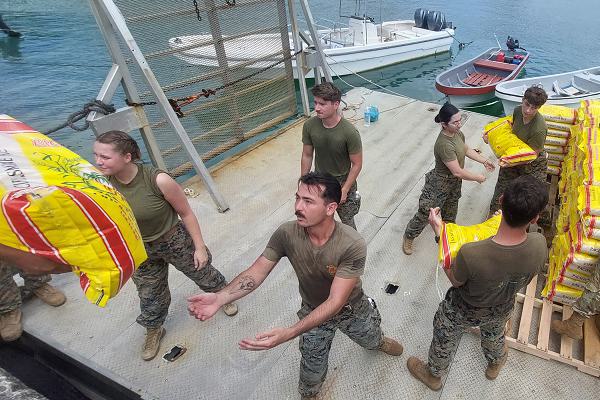
Federated States of Micronesia. (July 15, 2024): Most Americans are unaware of the special relationship we enjoy with this island country in the Pacific. In this photo by Gunnery Sergeant Sean Arnold, Marines and sailors provide humanitarian disaster relief preparation by offloading bags of rice during exercise Koa Moana 24 held here this week.
The Federated States of Micronesia (FSM) is a country spread across the western Pacific Ocean comprising more than six hundred islands and is made up of four separate states, Pohnpei, Kosrae, Chuuk, and Yap. The island chain is in the “Ring of Fire,” an area characterized by active volcanos and frequent earthquakes. In addition to the threats of earthquakes, tsunamis, and volcanic eruptions, the FSM is also vulnerable to typhoons, droughts, and landslides. To make matters worse, climate change is driving up sea levels resulting in shortages of drinking water and food insecurity. With most of its population living on the coast, the FSM is particularly vulnerable to rising sea levels.
This is where America’s special relationship comes in.
In 1986, the United States signed a Compact of Free Association with the FSM that provides for financial assistance, a pledge to defend the FSM's territorial integrity, and uninhibited travel for FSM citizens to the U.S. In return, the FSM provides the United States with unlimited and exclusive access to its land and waterways for strategic purposes. Each year, hundreds of FSM citizens serve in all branches of the U.S. Armed Forces and further their education in the United States. The FSM also uses the U.S. dollar as its currency.
- Details
- Hits: 7531
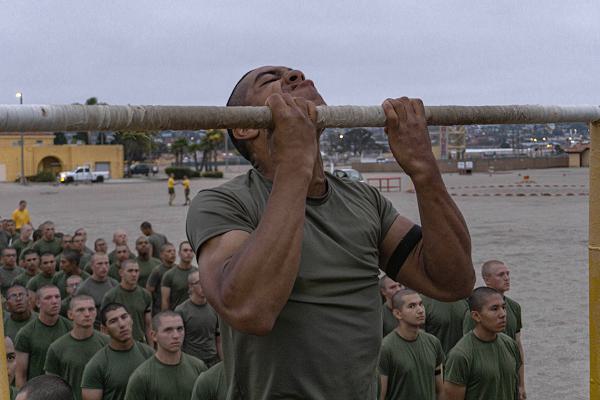
Marine Corps Recruit Depot San Diego, California. (July 18, 2024): The Marines want to know: Do you have a moral cause, something you are willing to fight for more powerful than the urge to quit? In this photo by Lance Corporal Alexandra M. Earl, a recruit performs pullups during a Marine Corps Physical Fitness Test, or PFT, that is one of the toughest in the world. Each year, Marines must demonstrate that they are physically fit for combat, regardless of the job they do. For these few proud warfighters, physical conditioning is a way of life that begins on their first day of Basic Training.
Before they even begin recruit training, aspiring Marines must pass the Initial Strength Test (IST) and are strongly encouraged to report to training with scores well above the minimum standards. The IST begins with three pull-ups or thirty-four push-ups (2:00 time limit), a planking exercise, followed by a 1.5 mile run in less than 14 minutes.
Once accepted for training, prospective Marines must build their conditioning to pass the PFT before they graduate Basic. The standard increases to more pull ups, timed planks, and an even longer 3-mile timed run that recruits must complete in less than twenty-eight minutes.
- Details
- Hits: 2751
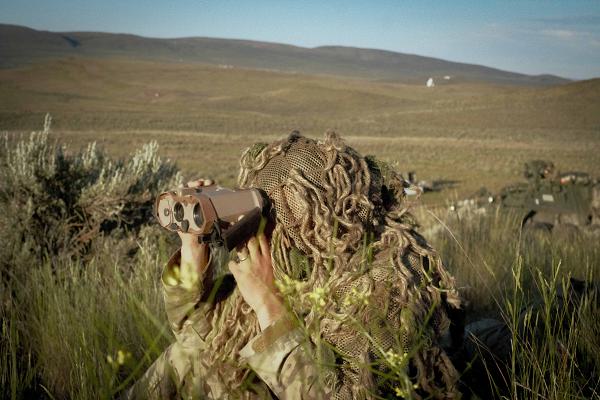
Yakima Training Center, Washington. (July 19, 2024): When they absolutely, positively don’t want to be spotted, America’s warfighters depend on the camouflage provided by the famous Ghillie suit. In this photo by Army National Guard Sergeant Remi Milslagle, Specialist Mackenzie Jones blends into his surroundings while participating in a live-fire range exercise.
The word “ghillie” comes from the Scottish gille or outdoor servant. The name likely referred to attendants that assisted sportsman with recreational shooting. The Scotts themselves prefer to credit the Ghillie Dhu, an earth spirit covered with moss to conceal itself. The first recorded use of the Ghillie suit in combat was during the English Boer Wars in South Africa at the turn of the century and it was quickly adopted by the first English sniper units.
Modern Ghillie suits are a type of camouflage clothing designed to resemble the surrounding environment such as foliage, snow, or sand. The suit “breaks up the profile” of a shooter by creating a three-dimensional image that moves in the wind the same as the surrounding foliage. These suits are typically made of netting or cloth covered in loose strips of burlap made to look like leaves or twigs and augmented with scraps of live foliage.
Although an excellent camouflage tool, the Ghillie suit has its disadvantages. First, the suit is extremely heavy and can be ridiculously hot. Even in moderate climates, temperatures inside a Ghillie can reach 122 degrees. Moreover, the fabric retains water which dramatically increases its weight. The military is experimenting with a more light, breathable material to address the problem.
- Details
- Hits: 4394
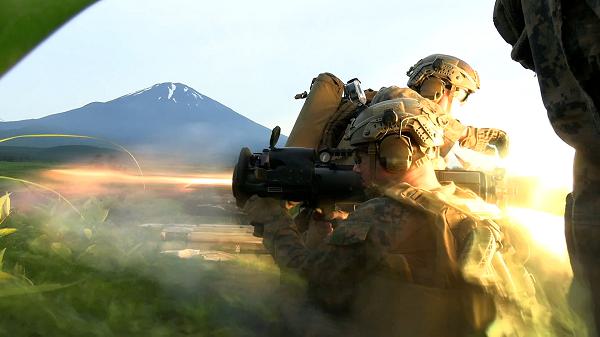
Camp Fuji, Japan. (July 10, 2024): When you hear the word “Bazooka”, it conjures World War II images of gallant infantrymen confronting an enemy tank at point blank range. In this photo by Corporal Anna Geier, Marines with 4th Marine Regiment fire the modern version of the Bazooka, the M3E1 Multi-purpose Anti-armor Anti-personnel Weapon System or (MAAWS).
The Bazooka was adopted by the Army in World War II to attack tanks and fortified positions at extremely close range. The weapon consisted of a steel tube equipped with a hand grip, a trigger, and a sighting mechanism. Today’s MAAWS is a reloadable, recoilless rocket that is reusable and can fire illumination, smoke, and airburst rounds. It is designed for anti-personnel, armor penetration, and bunker busting. Unlike its predecessors, the MAAWS has greater range and can hit moving targets with the aid of its modern fire control system. The system incorporates an integrated laser range finder and a modular ballistic computer capable of programming high explosive air-bursting ammunition and engaging moving targets at up to 2,000 feet.
The weapon is operated by a two-man crew, a gunner who carries and fires the weapon and a loader who carries four rounds of ammunition. As the gunner takes aim, the loader checks the area behind the weapon for people and obstacles in the back-blast area. Unlike its single shot cousin, the M72 Light Anti-tank Weapon (LAW), the additional rounds available to the MAAWS increase an infantry squad’s options when attacking targets.
- Details
- Hits: 1351
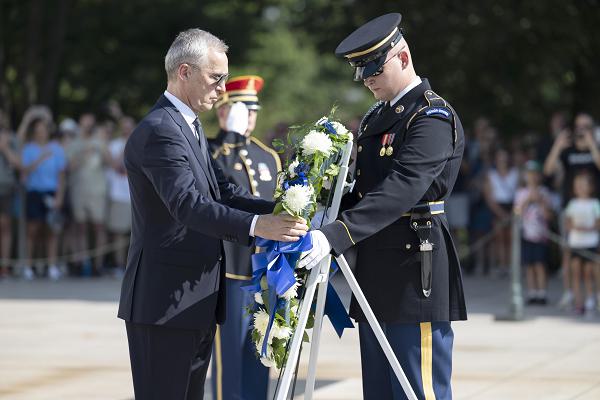
Arlington National Cemetery, Virginia. (July 18, 2024): NATO leaders declared this week that Ukraine joining the alliance is “irreversible”, drawing an expected angry response from Russia. In this photo by Elizabeth Fraser with Arlington National Cemetery, NATO Secretary General Jens Stoltenberg participates in a wreath-laying ceremony at the Tomb of the Unknown Soldier. Ukraine dominated the agenda at this 75th meeting of the alliance and several steps were announced to help them dislodge the Russian army from their country.
At the meeting, NATO members agreed to boost their industrial production to keep pace with Russia’s manufacturing of military supplies. The U.S., Dutch, and Danish governments announced they would be sending additional F-16 fighters to Ukraine that should be operational by summer. After extensive allied training, the first group of Ukrainian F-16 pilots graduated earlier this year.
- Details
- Hits: 3609
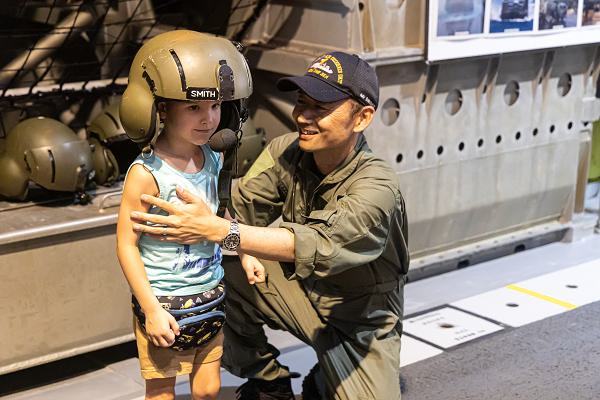
Joint Base Pearl Harbor-Hickam, Hawaii. (July 16, 2024): The world's largest international maritime exercise, RIMPAC 2024, kicks off this week with a focus on disaster and humanitarian relief. In this photo by Petty Officer 2nd Class Ryan LeCompte, a young visitor tries on Navy head gear aboard the Japanese Maritime Self-Defense Force amphibious transport dock ship JS Kunisaki during Open Ship Day.
The exercise is held biennially during June and July of even-numbered years at Honolulu. This year eight countries participated with five ships, five landing craft, five aircraft, multiple land forces, and over 2,500 total participants. This is the 29th RIMPAC exercise that began in 1971 and the event was attended by representatives from Australia, Canada, New Zealand, the United Kingdom. Other participating nations include Chile, Colombia, France, Indonesia, Japan, Malaysia, the Netherlands, Peru, Singapore, South Korea, and Thailand.
This year’s emphasis is on Navy medicine and the more than 44,000 highly trained military and civilian health care professionals that provide expeditionary medical support to warfighters on, below, and above the sea, and ashore. The exercise also included amphibious operations, gunnery, missile, anti-submarine, and air defense exercises. Special sessions were held on counter-piracy, mine clearance operations, explosive ordnance disposal, and diving and salvage operations. A highlight of the event was the sinking of the former USS Tarawa, an 820-foot-long amphibious assault ship that provided a target for a variety of sophisticated munitions.
RIMPAC provides a unique training opportunity for participating navies while fostering cooperative relationships among participants critical to ensuring the safety of sea lanes and security on the world's oceans.