

- Details
- Hits: 3008
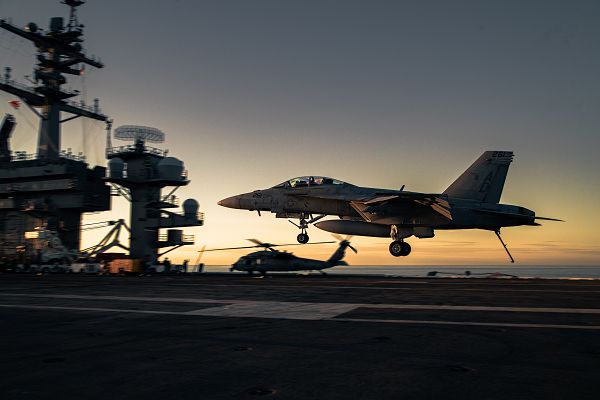
Atlantic Ocean. (November 12, 2023): Pilots call it a “controlled crash landing” and it is one of the most dangerous tasks military aviators face every day. In this photo by MC2 Nicholas Russell, an F/A-18F Super Hornet attached to Strike Fighter Squadron 106 lands aboard the Nimitz-class aircraft carrier USS George Washington while the ship is underway.
Imagine flying a high-speed combat aircraft in foul weather and having to land on a rolling, pitching runway that is only five hundred feet long. Oh, and did I mention this feat is often accomplished at night in total darkness.
The process begins when the Landing Signal Officer aboard the carrier clears the pilot to land. In a normal scenario, various returning planes “stack up” in the skies above the carrier and are granted permission to land by the Carrier Air Traffic Control Center based on their fuel level. Once given the ok, pilots break from their circulating pattern, release their tailhook, and head toward the stern of the ship.
The goal is to grab one of four “arresting” wires or cables strung across the landing area spaced about fifty feet apart and connected to a series of hydraulic pulleys below deck. Pilots typically aim for the third wire as it is the safest target. Aviators avoid the first wire as it is dangerously close to the end of carrier deck and, if they are too low, could cause them to crash into the stern of the ship. To be qualified to fly from a carrier, pilots must demonstrate they can hit the third wire consistently in all weather conditions day and night.
To pull off this “crash landing,” pilots must approach the landing area at exactly the right angle. To do this, pilots rely on a Fresnel Lens Optical System, or “Lens,” that consists of a series of lights mounted to a gyroscope for stability on a pitching deck. The Lens directs these lights at various angles into the sky and pilots will see different lights depending upon their angle of approach. If they are right on target, pilots will see an amber light, colloquially referred to as the “meatball,” along with a row of green lights. If the meatball is above the set of green lights, the plane is coming in too high. If the amber light is below the set of green lights, the plane is coming in too low. If the pilot’s trajectory is way too low, the Lens transmits a red light to the pilot to wave off and come around again.
- Details
- Hits: 2392
Eglin Air Force Base, Florida. (November 15, 2023): The year was 1942 and the Japanese fleet prepared to ambush the Americans in the Battle of Midway. Unfortunately for them, their ammo loaders failed at their tasks and the outcome of the battle turned the tide of the Pacific War. History records that U.S. fighters came upon Admiral Nagumo’s fleet as they were switching bombs on their aircraft, explosives lying all around, creating a powder keg that destroyed the Japanese force.
American Airmen today are determined not to repeat that mistake.
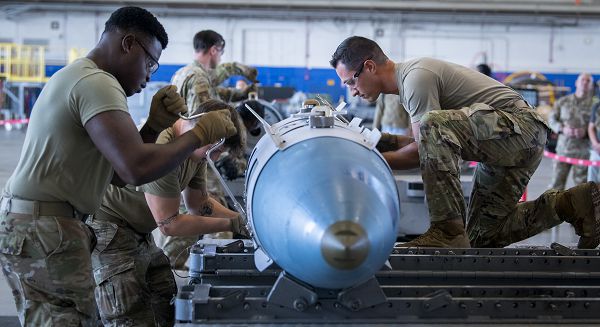
In this photo by Samuel King Jr., Senior Airman Yvener Desir, Airman 1st Class Andrew Bankson and Staff Sgt. Michael Rosa with the 96th Maintenance Squadron race against time to best the efforts of other ammo teams to win the annual weapon loading competition. Seen here building a Joint Direct Attack Munition GBU-31, the ammo teams quickly and precisely build the bombs to be loaded onto an F-15 Eagle and F-16 Fighting Falcon.
This event is designed to evaluate weapon loading teams under the pressure they would experience in actual combat. Affectionately called a “Load Toad,” ammunition loaders are often the uncelebrated key to launching successful strikes against the enemy. In an average day, Load Toads equip ten or more aircraft with a wide variety of weapons in a highly choreographed ballet that requires hours and hours of practice until they know the routine by heart.
Read more: “Load Toads” Skill Under Pressure Key To Arming Aircraft
- Details
- Hits: 1083
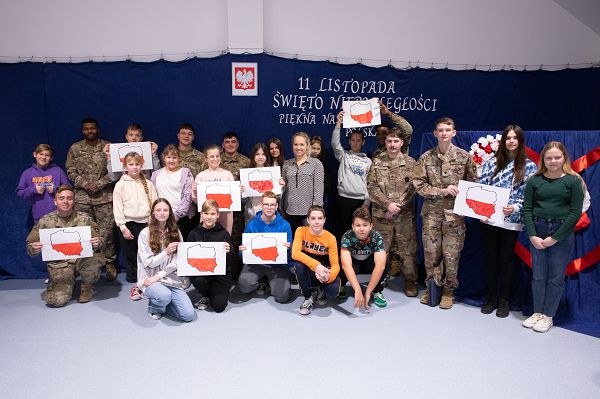
Rożyńsk Wielki, Poland.(November15, 2023): The American military has installations all over the world so every servicemember needs to get comfortable interacting with local populations. In this photo by Sergeant Cesar Salazar Jr., U.S. Army Soldiers with Bravo Company, 2nd Battalion, 69th Armored Regiment, 2nd Armored Brigade Combat Team, 3rd Infantry Division, join students at Primary School Cardinal Stefan Wyszyński to show off crafts they made together. These Task Force Marne Soldiers met with students and faculty to learn more about each other’s cultures and ways to connect with local citizens.
Operating from a large NATO base near their village, the Americans wanted the local children to know they are friendly and are here to protect them from harm. Gatherings like these help U.S. troops understand Polish culture, history, and local customs while sharing their unique stories with their hosts.
The Army makes it a priority to give troops the chance to interact with local populations to develop positive relations and a sense of trust. The 3rd Infantry Division’s mission in Europe is to engage in multinational training and exercises across the continent working alongside NATO allies.
- Details
- Hits: 1201
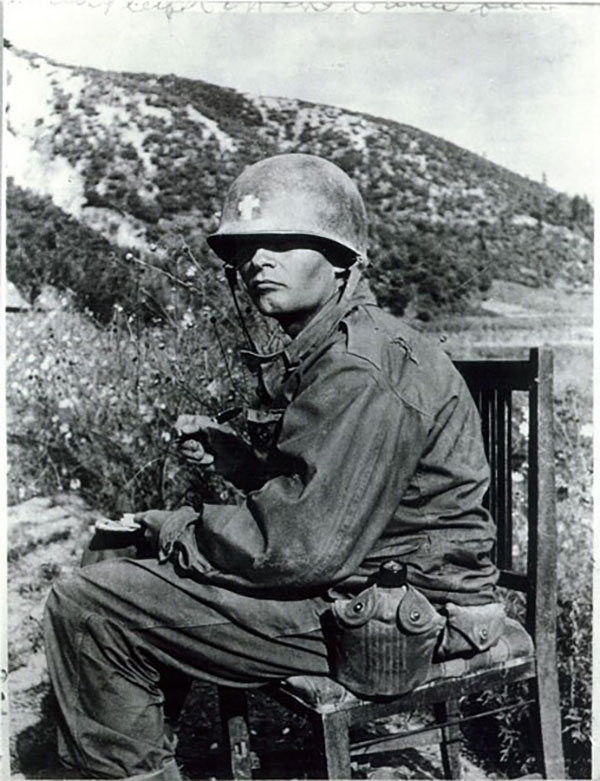
Washington D.C. (November 12, 2023): On the 238th anniversary of the Chaplain Corps, the Army recognized the unsung role of military clergy by celebrating the heroics of Capt. Emil J. Kapaun, a selfless priest who died as a prisoner of war in 1951 and was awarded the Medal of Honor.
During the Korean War, Kapaun was serving with the 3rd Battalion of the 8th Cavalry Regiment during the Battle of Unsan when Chinese forces encircled his battalion. Kapaun ran fearlessly between foxholes, DOW ging bullets to provide comfort and reassurance to his outnumbered fellow soldiers. He repeatedly exposed himself to enemy fire to recover wounded men and, when he couldn’t drag them, dug trenches around them to shield them from harm. Ignoring numerous opportunities to escape, Kapaun was taken prisoner of war on November 2, 1950.
Once inside the dismal prison camps, Kapaun risked his life by sneaking around the camp after dark, foraging for food, caring for the sick, and encouraging his fellow Soldiers. He endured starvation, beatings, rampant illness, and sub-zero temperatures and never lost his faith and determination to resist.
Inspiring thousands of his comrades to fight to survive, he died while in captivity and was awarded the Medal of Honor on April 11, 2013.
- Details
- Hits: 1837
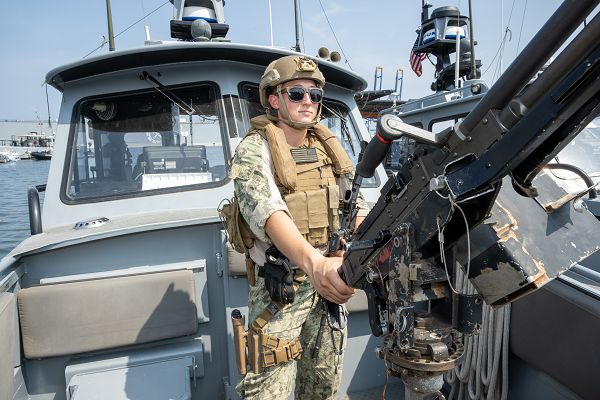
Camp Lemonnier, Djibouti (November 1, 2023): The Red Sea, between Iranian ally Yemen and the impoverished nation of Eritrea, is a tough neighborhood for America’s Navy. In this photo by MC1 Maria A. Olvera Tristan, Builder 2nd Class Payton Carl, a gunner from Navy Maritime Expeditionary Security Squadron 11, stands watch at Dorahleh, Djibouti. Based at Camp Lemonnier, Squadron 11 is charged with protecting thirty-eight tenant commands and visiting naval vessels with around the clock port security and escort operations. The base is home to the three warfare specialties including Military Working Dog teams, Army Quick Reaction Forces, and Djiboutian port police.
Now called MSRON forces, today’s riverine community can trace its roots to the fearless small boat teams that plied the deltas of Vietnam. Since the bombing of the USS Cole in 2000, MSRON11 has used its small boat fleet to police one of the world’s busiest shipping routes. The unit patrols the Bab-el-Mandeb Strait which is the gateway from the Red Sea to the Indian Ocean.
- Details
- Hits: 3571
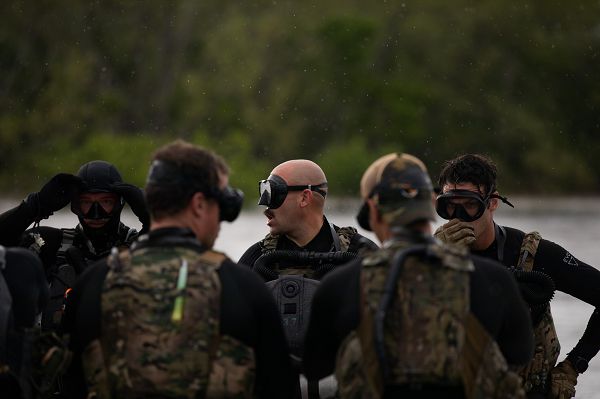
Naval Air Station Key West, Florida. (November 2, 2023): In a display of incredible stamina and skill, Team 4 from the Army’s 5th Special Forces Group won the Best Combat Diver Competition at the Special Forces Underwater Operations School, beating out the Navy SEALs.
The three-day event featured13 two-person teams from U.S. Army special operations and Navy SEALs competing in events that assessed their academic rigor, physical grit, and mental agility. Founded in 1964, the Special Forces Underwater Operations School is the premier institution developing expert special operators in underwater and maritime operations.
The school trains more than three hundred service members annually and assists another thousand troops in preparing for deployment or obtaining certifications. The school’s instructors are made up of the nation’s elite; Army Special Forces, Army Rangers, Navy SEALs, and Air Force pararescue men who are experts at submarine exfiltration and infiltration. The school offers a Combat Dive Qualification Course, a Combat Diving Supervisor's Course, and a Diving Medical Technician Course.
The advantage of using submarines to insert or recover special operators is the difficulty of the enemy detecting them. Done properly, these insertions occur and the adversary doesn’t know these commandos and the subs carrying them have ever been there.
Submarine-borne infiltration and exfiltration is one of the most dangerous missions in the military and requires diving from a submarine’s “lock-out” chamber. A certain number of Navy submarines are equipped with these so-called “trunks” that are used to get operators into and out of a submerged submarine. When the sub arrives at the infiltration point, the special operators enter the trunk wearing their scuba gear and the trunk is flooded to match the outside pressure. Once equilibrium has been achieved, operators open the trunk's hatch and head to their target, taking with them any necessary gear, such as inflatable boats.