


- Details
- Hits: 1554
 In this edition of Support Our Troops.org, we present the fascinating world of America’s K-9 teams and the many ways they keep our servicemembers safe. Military working dog teams participate in dangerous missions all over the world, often in extreme conditions for extended periods. These K-9 handlers work long hours, many times away from home and family, while the hone the skills that save lives in combat.
What began as a request from a dog handler for “hard to get” K-9 supplies resulted in Support Our Troops.org founding the Military Paws Program to assist the 2,000 or so military working dog teams operating around the world.
Here’s how it works.
Support Our Troops.org realized that, while our armed forces do an excellent job providing the basics, America’s K-9 teams lacked some of the “comfort” items commonly enjoyed by civilian pet owners.
Support Our Troops.org collects and repackages donated comfort goods for K-9 teams, ranging from cooling vests to toothpaste, and ships them to military bases at home and abroad.
Even a small donation goes a long way towards shipping costs and bulk purchases. Please go to our secure site https://supportourtroops.org/donate to make your tax-deductible contribution today!
If you wish to personally shop for America’s K-9 teams, go to our website https://supportourtroops.org/k-9-soldier-treats for a list of comfort items that are the hardest to get and most in demand by our troops.
- Details
- Hits: 1650
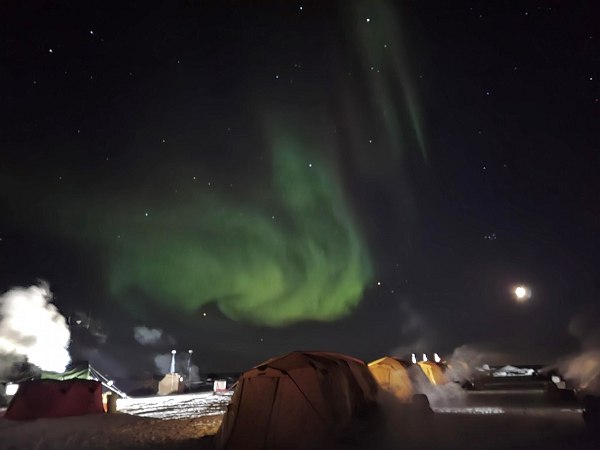
Ice Camp Queenfish (March 10, 2022): America’s mastery of the seas is constantly challenged in the Artic by an increasingly belligerent Russian Navy and Air Forces. Unsafe flybys, jamming radars, blocking GPS signals, and close encounters at sea are but a few of the provocative actions by Russia that have U.S. military planners concerned.
To better understand the threat, it is helps to know the geography involved. Russia is the largest of seven countries that border the Artic with a frontier of nearly 15,000 miles stretching from the Barents Sea in the west to the borders of Norway and the Bering Sea in the east. Economically, Artic resources account for up to 20 percent of Russia’s gross national product.
Russia blames NATO expansion for its more confrontational posture, but military planners fear these new, more hostile actions foreshadow a plan to control the northern sea lanes.
What Russia, and to a lesser extent China and North Korea, will soon realize is America has the world’s most sophisticated armed force, including a tough new airborne division, in their back yard.
- Details
- Hits: 1284
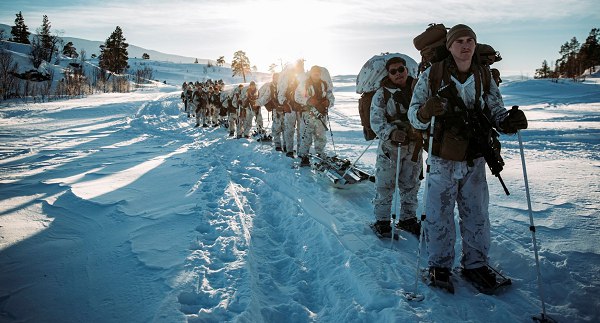
Setermoen, Norway. (February 22, 2022): In January 2021, the Navy released it’s “Blue Artic” Strategy detailing America’s response to multiple threats from the Russian Federation. Navy analysts warn “Russia is investing heavily to enhance its Artic defense and economic sectors” while “modernizing its military capabilities, especially its Northern Fleet.”
American ally and NATO member Norway, with over 1,600 miles of coastline including a 121-mile land bridge with Russia, is determined to enforce the right of safe passage for all international traffic.
And for good reason.
The Artic today contains 30 percent of the world’s natural gas, 13 percent of the earth’s oil, and over a trillion dollars of rare earth metals that are essential to military production.
- Details
- Hits: 1223
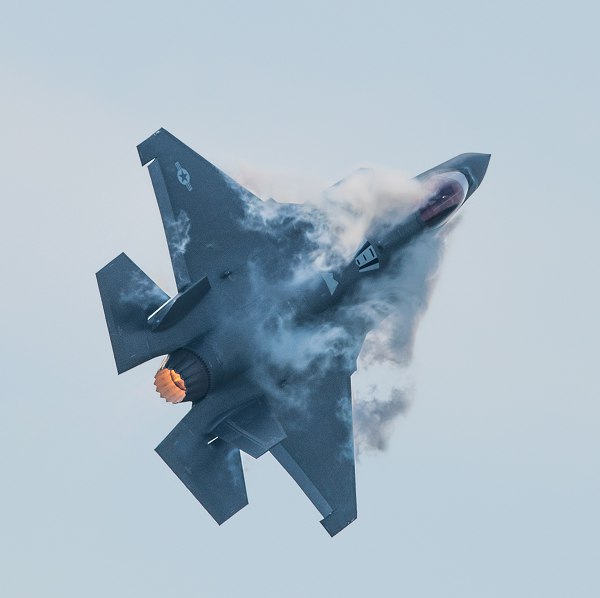
Eielson Air Force Base, AK. (June 1, 2022): The Army is not the only service that is bulking up its forces in the Artic. America’s Air Force has deployed the bulk of its lethal F-35 Lightening jets to Alaska, planes with a maximum speed of 1,200 mph and a range of 900 nautical miles. Packed with stealth technology, the Lightning carries multiple missiles internally to hide its signature while jamming enemy radar with electronic countermeasures. This deployment gives Alaska the most fifth-generation fighters than any other place in the world.
In this photo by Senior Airman Alexander Cook, Captain Andrew “Dojo” Olson, F-35 Demonstration Team pilot and commander performs a high-speed pass in an F-35 Lightning during an air show in Alaska. (Not to worry, that is an air effect… not a fire in the cockpit!).
- Details
- Hits: 1383
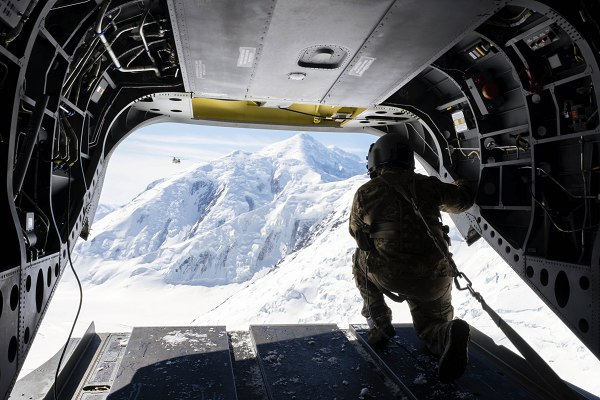
Denali National Park, AK. (May 31, 2022) The creation of a new airborne division is but a few of the changes underway in Alaska today. The Army is disbanding its existing Stryker Combat units as these vehicles proved unsuitable for operating in extreme cold conditions. They will be replaced with traditional airborne forces capable of deploying over great distances and “air mobile” helicopter units for local mobility and support.
In strategic terms, 11th Airborne soldiers will “train the way they fight”, in harsh conditions, during extreme cold (50 degrees below zero) and at high altitudes. By establishing this new Artic command, America will ensure its northern fighting forces have the right training, clothing, and equipment to “thrive, not just survive” in the Artic.
In this photo by Benjamin Wilson, a soldier from the Sugar Bears of B Company, 1st Battalion, 52nd Aviation Regiment kneels on the ramp of a Chinook helicopter while looking out at the seemingly endless Artic wilderness. The Sugar Bears, and brave soldiers like them, will soon play a featured role in defending America’s northern flank.
- Details
- Hits: 1556
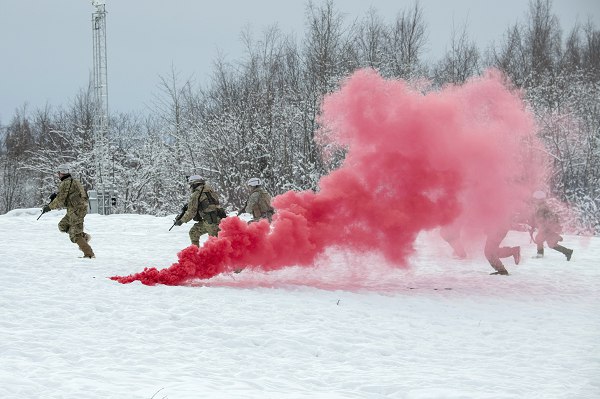
Fort Elmendorf-Richardson, AK. (June 6, 2022): The key to America’s new Artic strategy will be the reactivation of the 11th Infantry Division (Airborne) to be simultaneously based at Forts Wainwright and Elmendorf-Richardson, Alaska, and manned by up to 16,000 soldiers. Dubbed the “Artic Angels”, this new airborne division is being drawn from elements of the Hawaii based 25th Infantry Division. For the first time, all Army forces in the Artic will fall under one command which should boost morale among our nation’s newest cold weather warriors.
In this photo Airman Emily Farnsworth, Army paratroopers assault a simulated enemy position using smoke for cover during exercises at base Elmendorf-Richardson in Alaska’s forbidding wilderness.