


- Details
- Hits: 1518
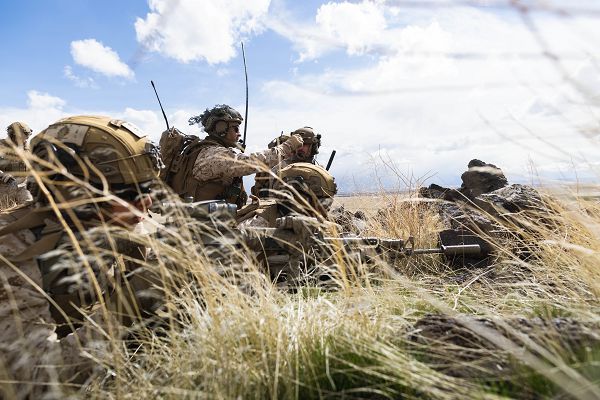
Grasmere, Idaho. (May 8, 2023): When one thinks “Air Force”, images of fighter jocks and crisp blue uniforms come immediately to mind. In the picture above by Lance Corporal Juan Torres, Marines from the 1st Marine Division locate their targets alongside Air Force Joint Terminal Attack Controllers at Saylor Creek Range at Grasmere, Idaho. Marines and Air Force personnel teamed up to test their skills in realistic combat conditions during Exercise Garnet Rattler held here recently.
A Joint Terminal Attack Controller JTACs (also called Forward Observers) directs the actions of attacking military aircraft engaged in close air support of Marine units on the ground and they do so often well behind enemy lines. Exercise Garnet Rattler centers around a comprehensive training program to enhance coordination between Air Force joint terminal attack controllers and other Marine Corps personnel involved in ground operations. The exercise involved 11 Marines undergoing advanced training as JTACs in simulated urban terrain using live ammunition and aided by close air support from neighboring units.
The training program included advanced technology, such as the Target Handoff System version 2.0, which allows JTACs to communicate with other units and provide critical information to the ground force commander. Saylor Creek is one of only a handful of firing ranges that can accommodate live fire exercises to hone close air support skills.
- Details
- Hits: 1556

St. Louis, Missouri. (May 8, 2023): In this photo by MC2 Jason Waite, Sailors from across the fleet are in Missouri for St. Louis Navy Week to emphasize the importance of the U.S. Navy to the state of Missouri and to participate in various community events. Navy Weeks is designed to develop a bond between Americans and their Navy and to showcase why today's Navy is important to America's prosperity and its national defense.
This year’s event took place at Whiteside Middle School in Belleville, Missouri and featured a command performance by the Navy Band Great Lakes to the delight of the children, their parents, teachers, and staff. The students got a chance to interact with the musicians and ask questions about the types of jobs available in today’s Navy.
The Navy Band Great Lakes was formed in 1918 during the final months of World War I. Initially used to sell war bonds, the band soon grew to over 350 Sailors and became what President Woodrow Wilson proclaimed, "the greatest band in the world.”
Another local school, Sigel Elementary, was treated to a ceremonial guard display by the Navy’s famous exhibition drill team. Established in 1931, the drill team conducts Navy funerals at Arlington National Cemetery for America’s fallen.
The Navy invests heavily to connect with their host communities and to promote public support for our nation’s Sailors and Marines.
- Details
- Hits: 1516
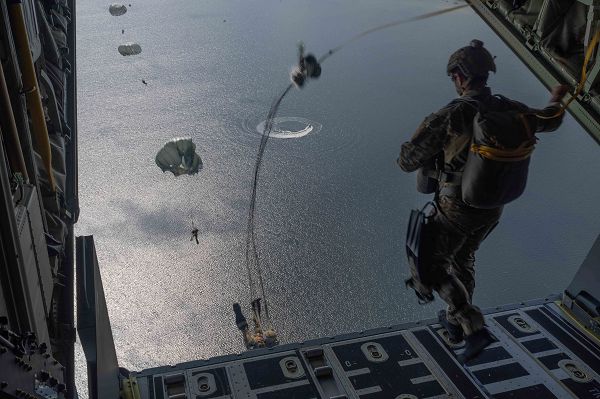
Hurlburt Field, Florida. (May 12, 2023): They go where others fear to go and do what must be done to protect this great nation. They are the Air Force 24th Special Operations Wing. the very cream of U.S. military aviation. In the above photo by Technical Sergeant Jael Laborn, Air Force Special Tactics operators conduct static line jump training during Emerald Warrior 2023, the largest joint exercise involving U.S. Special Operations Command forces each year.
The 16th annual Emerald Warrior exercise was held at multiple locations across Florida and Puerto Rico and featured one of the most sophisticated and versatile aircraft in the U.S. inventory, the MC-130H Combat Talon II.
The Combat Talon II’s mission is to infiltrate, resupply, and extricate special operations forces and equipment in hostile or denied territory. Its secondary mission includes psychological operations and helicopter air refueling.
The aircraft features terrain-following radars that allow the Talon to fly “nape of the earth” at altitudes as low as 250 feet, even in adverse weather conditions. Recent changes to the basic C-130 include the addition of a receptacle that allows for in-flight refueling of special operations forces and combat search and rescue helicopters. Its navigation system includes dual ring-laser gyros, mission computers, and an integrated global positioning system that allows the Talon to locate and either land or airdrop on small, unmarked zones with pinpoint accuracy day or night. The Talon is protected by an extensive electronic warfare system that enables the aircrew to detect and avoid potential threats.
- Details
- Hits: 1643
Knoxville, Tennessee. (May 5, 2023): An outing in the wilderness nearly turned tragic for a hunter if it were not for the skill and bravery of a Tennessee Army National Guard Black Hawk helicopter crew. In the photo above, Crew Chief Sgt. Nicholas Kannard prepares to lower flight medic Sgt. 1st Class Tracy Banta to rescue the injured hunter who desperately needed medical attention.
The call came into the Tennessee Military Department and Emergency Management Agency that a person with severe leg injuries needed rescue from a rugged and remote area of the Cherokee National Forest. The 230th Assault Helicopter Battalion of the Tennessee National Guard sprang into action. Flying the versatile UH-60 Black Hawk helicopter, the aircrew arrived at the rescue site within 20 minutes.
The flight crew consisted of two pilots, Capt. Brandon Rodriguez and Chief Warrant Officer 3 Daniel Backus, crew chief Sgt. Nicholas Kannard and two flight paramedics, Sgt. 1st Class Nolan Ogle and Sgt. 1st Class Tracy Banta.
The crew chief, Kannard, lowered flight medic Sgt. Banta to the ground to assess the patient and prepare him for airlift. The patient and Banta were hoisted into the Blackhawk hovering above where additional medical treatment was provided. The rescue took just 13 minutes. Once everyone was safely on board, the aircraft flew to the University of Tennessee Medical Center in Knoxville. The entire rescue mission took less than an hour and a half.
- Details
- Hits: 1921
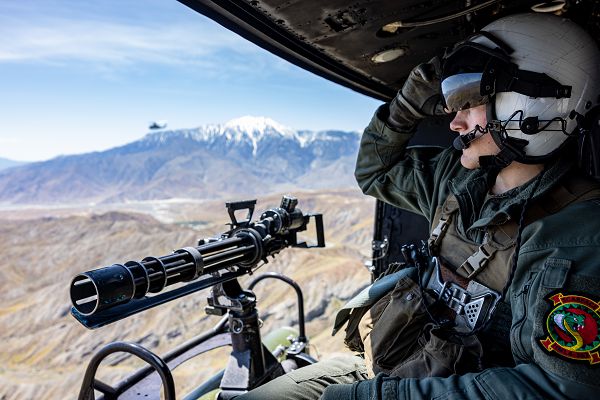
National Training Center, California. (May 3, 2023): In this photo by Lance Corporal Alex Devereux, Marine Corporal Bryce T. Hubbard, a UH-1Y Venom Crew Chief with Marine Light Attack Helicopter Squadron 367 observes his surroundings during a training flight during NTC Rotation 23-07. During the exercise, Squadron 367 supported the U.S. Army 75th Ranger Regiment and the 160th Special Operations Aviation Regiment as the sole rotary wing fire support element for long range assault force escort, close air support, and direct-action raids.
The Venom is one of the newest Marine Corps aircraft to replace the veritable UH-1N Huey which was first introduced in the 1970s. Manufactured by Bell Helicopters, the Venom provides command & control and assault support under day/night and adverse weather conditions. It can reach speeds approaching 190 mph and has a combat range of 130 miles. The Venom sports twin 70mm rocket launchers along with dual mounts for a variety of machine guns including the deadly GAU-17/A gatling gun.
Squadron 367 was commissioned during World War II and participated in combat operations on Peleliu and Okinawa. Reactivated during the Vietnam War, the squadron has served in every American conflict since. These highly skilled crews provide Marine Corps support to our nation’s most elite helicopter and special operations forces.
The 160th Special Operations Aviation Regiment, also known as the “Night Stalkers”, are assigned America’s toughest missions in all environments anywhere in the world. They are most famous for their role in the successful mission to capture and kill Osama Bin Laden.
- Details
- Hits: 7708
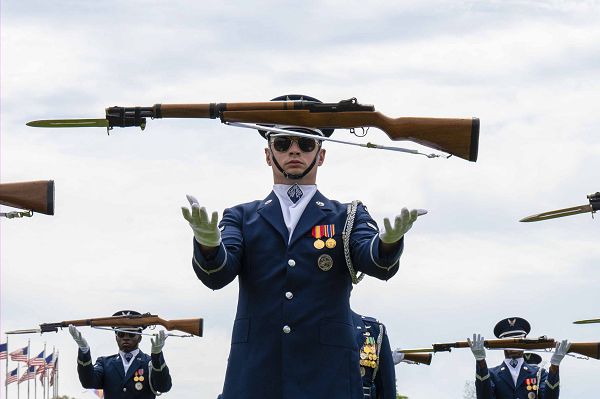
In this photo by Kristen Wong, Airman 1st Class Stephen Souza of the U.S. Air Force Honor Guard Drill Team tosses his rifle during a performance at the Joint Services Drill Exhibition at the Washington Monument in Washington, D.C. The team is an elite unit of 25 Airmen who train for up to eight to 10 hours per day, five days a week, to obtain their level of mastery.
Drill and ceremony is a military tradition dating back to our War for Independence in 1778. It was during that terrible winter at Valley Forge when George Washington and his exhausted troops, out of food, clothing, and medical supplies, began to see a breakdown of discipline.
Enter German Baron Friedrich von Stueben, an officer in the Prussian Army and a major general in the Continental Army from 1778-84. Baron von Steuben instituted military drill as part of a training program to improve discipline and organization of soldiers in the Continental Army. Von Stueben drew lessons from the ancient Romans who developed the first concept of drill by training troops on a task until it became second nature. Drill and ceremony made soldiers aware of their movements, to practice drills to ultimate precision, and to work together as a team.