

- Details
- Hits: 1933
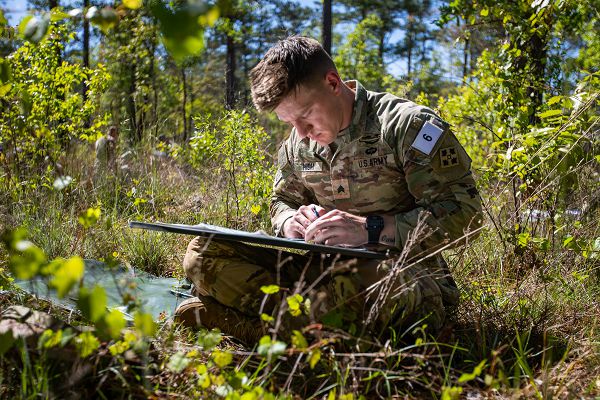
Ft. Benning, Georgia. (April 10, 2023): In this photo by Captain Alex Werden, Sergeant Austin High from 2nd Squadron, 1st Cavalry Regiment, 1st Stryker Brigade Combat Team, 4th Infantry Division uses a map and protractor to determine the distance between two plotted points during Best Mortar Competition at the “Home of Infantry”. Despite recent technologies like GPS, mortar crews continue to use the tried-and-true methods of a generation ago. The soldiers are tested on their ability to calculate the distance between their position and the target and then determine the elevation necessary to shoot their mortar rounds accurately.
Officially called Indirect Fire Infantrymen, they are a member of a mortar squad, section or platoon and are often the difference between life or death on the battlefield. Today’s mortar teams can trace their lineage to 1413 Korea where the first mortar was used in marine combat, the wan'gu (gourd-shaped mortar).Today’s indirect fire weapons are based upon the Stokes mortar, a portable version designed in 1915 by British weapons designer F.W.C. Stokes that became a prime allied weapon during World War I.
The Stokes mortar weighed just over a hundred pounds and could fire up to twenty-two rounds per minute with a range of up to 3,600 feet. Most modern mortar systems consist of four main components: a barrel, a base plate, a bipod, and a sight. The modern mortar is a muzzle-loaded weapon and is relatively simple to operate. It consists of a barrel into which the gunners drop a mortar round and, when the round reaches the base, it hits a fixed firing pin that fires the round.
Ammunition for mortars generally comes in two main varieties: fin-stabilized and spin-stabilized and both types can be either illumination (infrared or visible illumination), smoke, high explosive, or training rounds. Mortar bombs are often referred to, incorrectly, as "mortars". Today’s indirect fire squads employ three types of mortars with varying ranges and power (60mm, 81mm, and 120mm rounds).
- Details
- Hits: 1428
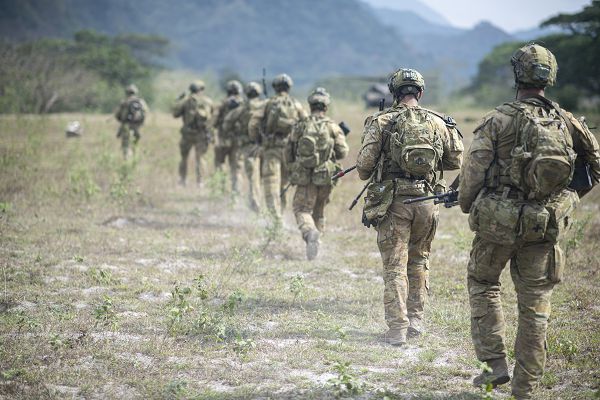
Philippines. (April 15, 2023): In this photo by Lance Corporal John Hall, Australian soldiers with Joint Australian Training Team-Philippines begin a jungle patrol during combined arms field training exercises at Colonel Ernesto Ravina Air Base, Philippines. This contingent of Aussies are taking part in Balikatan 23, an annual bilateral exercise between the Armed Forces of the Philippines and the U.S. military. The Australians are joining these maneuvers to improve coordination with allied units and as a statement of their support for the American led effort to confront Chinese aggression in the Indo-Pacific.
Chinese naval militia continue to harass and ram Filipino anglers working in the Philippines’ exclusive economic zone and Beijing warships and coast guard vessels are ignoring a 2016 international tribunal’s ruling dismissing its claims to much of the South China Sea. The Chinese are treating the region as its sovereign territory.
The Philippine government has responded by opening new military bases to the Americans and have greatly increased the size and tempo of military exercises.
Balikatan 23 involved three weeks of training focused on amphibious operations, command and control, humanitarian assistance, urban operations, and counterterrorism skills. The Australians will give lessons on combat shooting, urban clearance, tactical care of a combat casualty, and explosive breaching drills to Filipino infantry soldiers. The visitors spent months preparing to overcome the language and cultural barriers when working with foreign militaries. They even went as far as to employ Filipino speaking members to role-play various scenarios to enhance the realism of the training.
- Details
- Hits: 1403
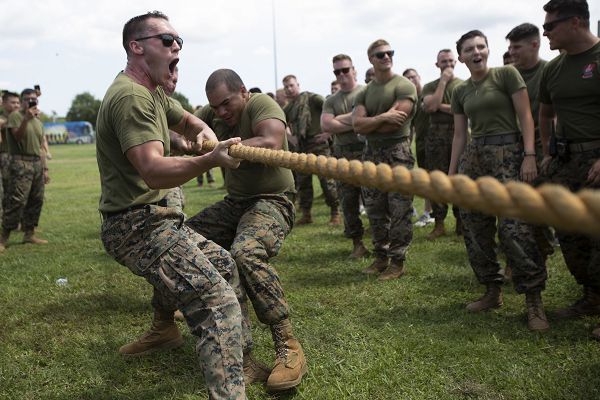
Norfolk, Virginia. (April 18, 2023): In this photo by Corporal Jack Chen, Marines with Fleet Maintenance Force Atlantic, Marine Forces Command, and Marine Forces Northern Command compete in a tug-of-war during a regional field meet held at Captain Slade Cutter Park, Virginia. The Marines went head-to-head in flag football, rowing, and kickball before battling it out with pugil sticks in simulated ground combat. Events like these challenge Marines to maintain their tough physical conditioning while instilling a sense of camaraderie among America’s finest. Marine Forces Command is responsible for planning, equipping, and deployment of Marine ground forces in the event of war.
- Details
- Hits: 2686
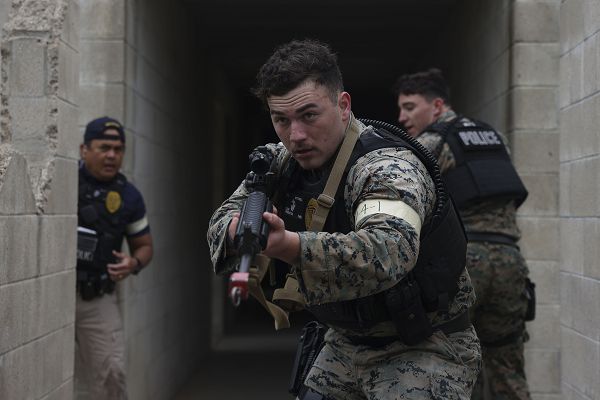
Camp Pendleton, California. (April 18, 2023): In this photo by Corporal Angela Wilcox, Marine Corporal Christopher Mitchell, a military police officer with the Provost Marshall’s Office, Security and Emergency Services Battalion, participates in an active shooter scenario during Semper Durus 23. The exercise is designed to improve regional command and control, interagency coordination, and an installation’s ability to respond to and recover from crises.
The role of the military police officer is like civilian law enforcement with some importance differences. Just like your local police department, military law enforcement officers prevent crime, control traffic, and respond to emergencies. But unlike local police officers, military police are responsible for force protection, counterterrorism, and corrections. Each branch has its own law enforcement division that is responsible for maintaining security and discipline while enforcing laws on military bases.
To become a military police officer, candidates must pass Basic Training and then complete the Military Police Basic Course at Fort Leonard Wood, Missouri. This 20-week program consists of One Station Unit Training and on-the-job instruction in police methods. Part of this time is spent in the classroom, and part takes place in the field. Students learn patrolling tactics, drug investigations, handling domestic disturbances, and how to secure highly sensitive military installations.
- Details
- Hits: 2278
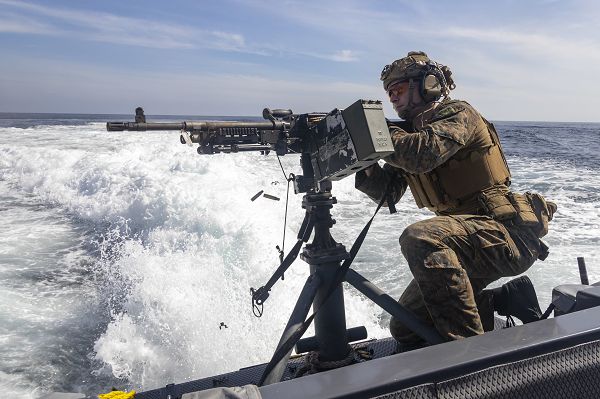
South China Sea. (April 17, 2023): In this photo by Corporal Austin Gillam, a Marine with Raid Platoon, 13th Marine Expeditionary Unit, fires the M240B machine gun while speeding along in a rigid-hull inflatable boat during gun range practice. One of the most elite elements in the Marine Corps, a Maritime Raid Force’s mission is to visit, board, search, and seize suspect vessels on the high seas, an extremely dangerous proposition indeed.
Once a potentially hostile vessel has been identified, the 13th Marine Expeditionary Unit (MEU) dispatches the raiders to investigate and, if necessary, subdue those aboard and seize control of the ship. During these high intensity encounters, the raiding party must also ensure the health and safety of any detained crewmembers until the vessel is turned over to the appropriate legal authorities. These raids are used to counter piracy, confiscate contraband, enforce international agreements, and deal with many other complex security-threatening situations.
- Details
- Hits: 1587
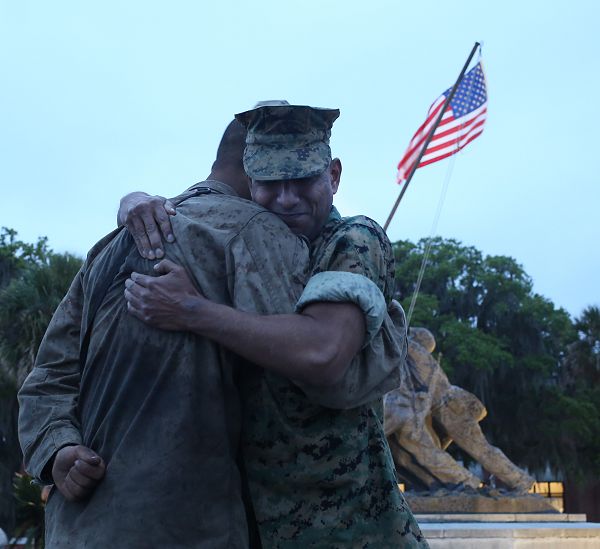
Parris Island, South Carolina. (April 13, 2023): In this photo by CWO3 Bobby Yarbrough, Private Joshua Kaza, a newly made Marine is awarded his Eagle, Globe, and Anchor by his father, Lt. Col. Babu Kaza at Marine Corps Recruit Depot Parris Island. Joshua is named after his father’s friend who was killed in Al Anbar Province, Iraq in 2004. Lt. Col. Kaza attended the Basic School (Officers candidate course) with then 1st Lieutenant Joshua Palmer and they shared a special bond as prior-service enlisted Marines. Kaza learned of his friend’s tragic death in the Battle of Fallujah and, together with his wife Tabitha, decided to name their unborn son in his honor. Private Kaza received his Eagle, Globe, and Anchor on April 8th—the anniversary of Palmer’s passing.