


- Details
- Hits: 3941
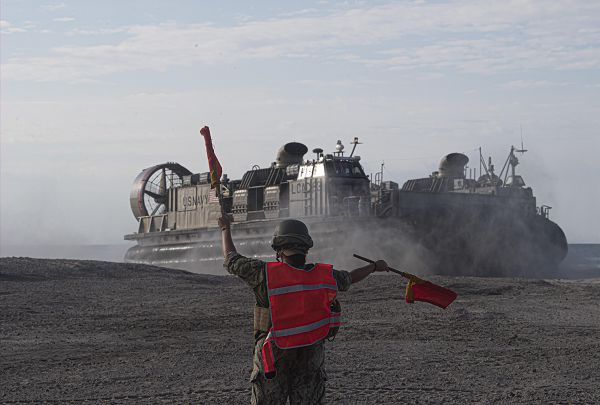
Camp Lejeune, North Carolina. (Aug. 9, 2023): In this photo by MC1 William Bennett IV, Boatswain's Mate 3rd Class Katrina Estevez, assigned to Beachmaster Unit 2, directs a Landing Craft, Air Cushion (LCAC) assault craft participating in U.S. Fleet Forces Command's Large-Scale Exercise 2023. These massive landing craft, built by Textron Marine Systems, can transport up to seventy-five tons of personnel and equipment directly onto the beach during an amphibious landing rather than unloading in shallow water. The LCAC has a crew of five and is powered by four gas turbine engines that can speed up to fifty miles per hour to the shore.
Ironically, this technical marvel traces its roots to Japanese landing boat designs “borrowed” by the Americans just before the start of World War II. In 1939, the Japanese led the world in landing craft with its advanced Daihatsu design. Unlike American boats at the time, the Daihatsu had droppable front ramps that enabled troops to quickly disembark from the bow, rather than having to clamber over the sides and splash into the surf.
This clever innovation was spotted by Lieutenant Victor Harold Krulak, a Marine intelligence officer who witnessed the Japanese using the Daihatsu in action during the invasion of China. Krulak teamed up with New Orleans boat builder Andrew Higgins to create a new bow design for thousands of “Higgins” landing craft used for troop landings during World War II.
- Details
- Hits: 1125
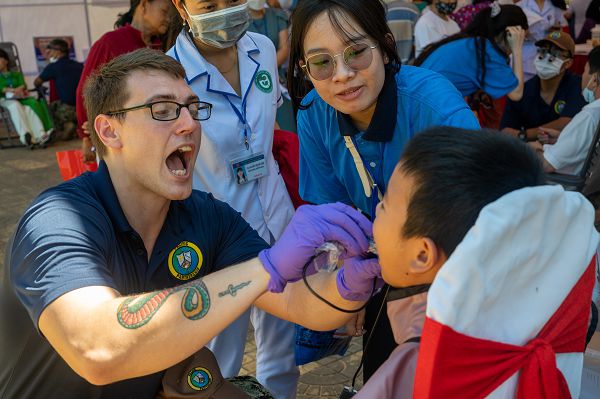
Tuy Hoa, Vietnam. (Aug. 10, 2023):We Americans are justly proud of our armed forces for its military prowess, but most do not realize the fantastic humanitarian work it does around the world. In this photo by Ensign Madison Kwok, Hospital Corpsman 2nd Class Logan Richardson prepares a dental x-ray for a Vietnamese patient at the Phu Yen General Hospital health fair during Pacific Partnership 2023. Now in its 18th year, Pacific Partnership is the largest annual multinational humanitarian assistance and disaster relief preparedness mission conducted in the Indo-Pacific.
This is the twelfth visit to Vietnam by U.S. forces along with Australia, Chile, Japan, the Republic of Korea, and the United Kingdom. During the five-month mission, 1500 personnel collaborated with local authorities on civic action preparedness in the field of engineering, disaster response, public health, and local host nation outreach.
addition to routine medical care, the U.S. team joined with Phu Yen General Hospital staff to perform hip and knee replacement operations for Vietnamese citizens at no cost. American engineers constructed a new building for Hoa Dinh Tay Primary School and renovated several other primary schools for local children.
This incredible humanitarian work gives servicemembers a chance to show their softer side, and the world to see the human side of the American people.
- Details
- Hits: 2166
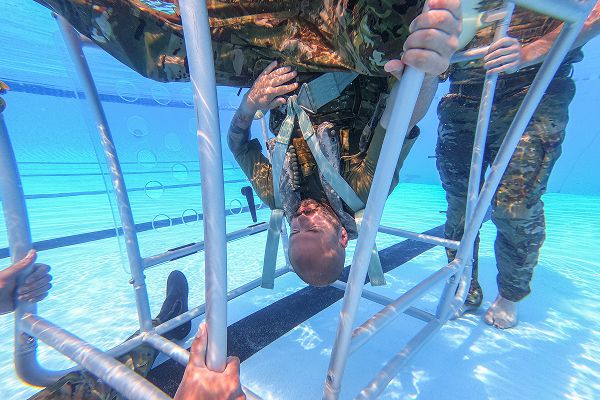
Malstrom Air Force Base, Montana. (August 15, 2023): In this photo by Senior Airman Mary Bowers, Captain Chase Todd, a pilot with the 40th Helicopter Squadron, holds his breath while undergoing Underwater Egress Survival Training, a brutal test of physical and psychological strength.
In this challenging program, instructors use a simulated helicopter body to train pilots and air crew how to escape from various underwater emergency situations. This device is officially called a Modular Amphibious Egress Trainer and consists of a pilot chair connected to buoys to represent the cockpit of an aircraft. Once strapped into their seat, trainees are then flipped upside down and submerged in water and must successfully extricate themselves from the aircraft before running out of air. Students practice dropping their gear, exiting the aircraft, and returning safely to the surface.
Unfortunately, some trainees panic in this situation.
- Details
- Hits: 4967
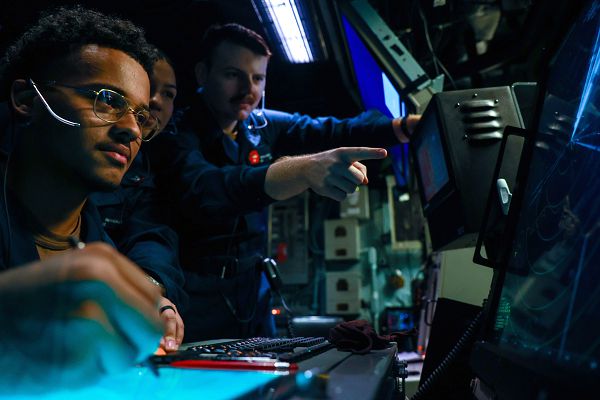
Mediterranean Sea. (Aug. 5, 2023): In this photo by MC3 Riley Gasdia, Sailors assigned to Tactical Air Control Squadron 21 track the movement of aircraft within the vicinity of the Wasp-class amphibious assault ship USS Bataan. Bataan and the Harpers Ferry-class dock landing ship USS Carter Hall are on a scheduled deployment to the U.S. 5th and U.S. 6th Fleet areas of responsibility. A Tactical Air Control Squadron (TACRON) establishes centralized control, coordination, and integration of air operations aboard warships during amphibious warfare. TACRON 21 deploys its detachments with amphibious squadrons to amphibious readiness groups around the world.
The concept of tactical air control was born during the British/German air wars in the initial stages of World War II. The Americans adopted the idea for use in its Pacific campaign against the Japanese and later in campaigns across Africa. As a result of these experiences, a concerted effort was made to set up and train several groups of personnel as Air Support Parties to guide combat aircraft.
As the Pacific war progressed, planners anticipated more naval landings combined with air assaults that would require one commander to coordinate the entire amphibious operation. Subsequent amphibious landings on Tarawa, Iwo Jima, and Okinawa saw the formation of teams of air controllers assigned to amphibious flagships to coordinate air and sea power and the Tactical Air Squadron was born.
- Details
- Hits: 7263
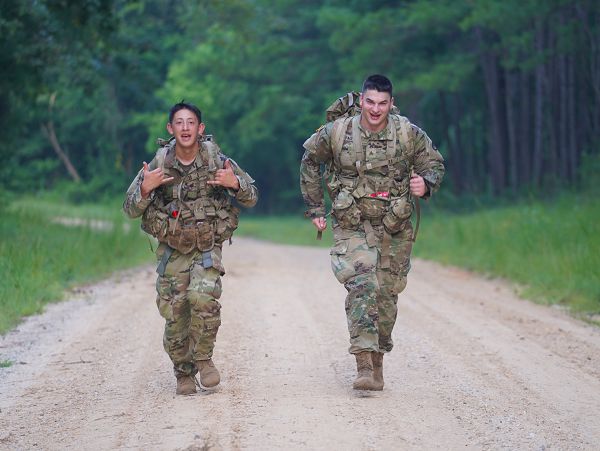
Fort Novosel, Alabama. (August 7, 2023): In this photo by Adam Sikes, Specialist Jason Riley, on the left, and Sergeant Jason Paglia appear in good spirits despite facing a grueling ruck march at Army Materiel Command's 2023 Best Squad Competition held here recently. Travelling long distances carrying a heavy rucksack, or “rucking,” is a practice as old as the American Army itself.
While the burdens carried by individual soldiers have changed over the years, the need for an efficient way for troops to transport weapons and equipment without bringing them to exhaustion has not changed. Today’s rucksack is essentially a large, rugged backpack whose name is derived from the German, “der rücken,” or “the back.” Every American soldier has endured a steep, seemingly never-ending incline, bent over, while carrying an 80-pound rucksack. What most troops failed to realize is the extensive research and development that has gone into this metal framed monster on their backs.
The first recorded instance of a warrior carrying a backpack was the famous “Otzi the Iceman,” a Copper age mummy encased in mountain ice for centuries that was discovered by a group of hikers in Italy. Otzi carried a bag along with his weapons and other gear in an animal skin pack supported by wooden stakes.
The forerunner of the modern backpack was designed by Henry Merriam In 1878 who received a patent for his “Knapsack” which included a metal frame that held the pack away from a soldier’s body.
During the Civil War, soldiers carried their gear in bundles built with sticks and canvas cloth which were a burden to carry and a constant source of irritation for Colonial troops. The advent of World War I brought the need for improved military backpacks and the “Haversack” was born. The Haversack was strapped onto the upper and lower back and held ammo, canteens, shovels, and other personal items.
- Details
- Hits: 1370
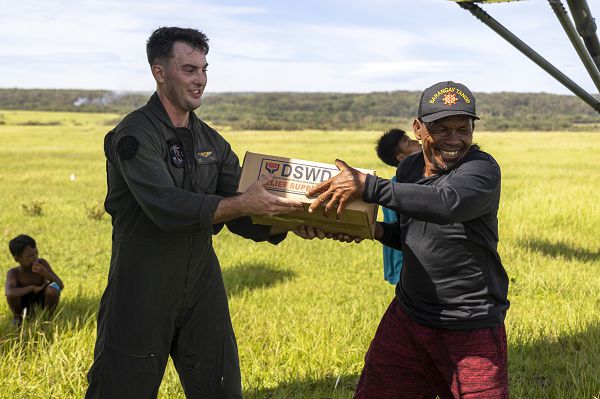
Fuga Island, Philippines. (August 7, 2023): In this photo by Sergeant Sean Potter, Corporal Daniel Lauer, a crew chief with Marine Medium Tiltrotor Squadron 163, Marine Aircraft Group 16, 3rd Marine Aircraft Wing passes emergency relief supplies to a Filipino citizen victimized by Typhoon Doksuri that struck the island causing widespread damage. At the request of the Philippine Armed Forces, the Marines fanned out across the island to provide lifesaving capabilities to local communities. During the three-day relief effort, the Marines delivered over 64,000 pounds of food and water to remote areas hardest hit by the storm.
Typhoon Doksuri made a direct hit on the Philippines, Taiwan, and China that killed eighty-seven people and injured 204 others while leaving behind a trail of catastrophic damage. Flooding was reported in nine out of seventeen regions affecting two million residents and causing over 300,000 to evacuate.
The Marines are often called upon to help in natural disasters due to their unique capacity to deliver vital relief supplies by sea and air. Their role as an amphibious force enables the Marines to use their shallow water vessels, helicopters, and tiltrotor aircraft to reach remote areas quickly in an emergency. Americans can be justly proud of our Marines using their skills to save countless lives around the world.