


- Details
- Hits: 2082
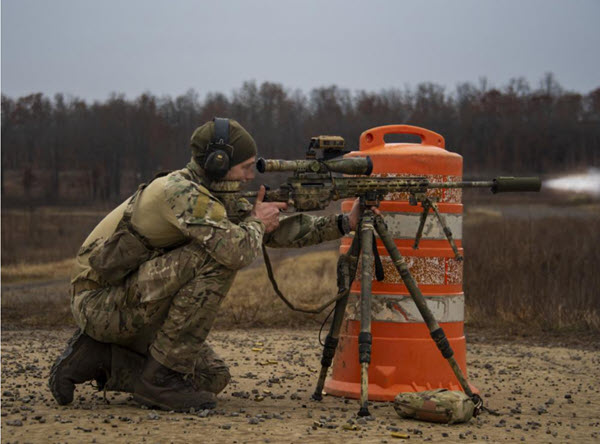
Fort Chaffee, Arkansas. (February 13, 2023): In this photo by Senior Airman Brandan Hollis, a National Guard soldier fires his weapon during competition at the 52nd Winston P. Wilson and 32nd Armed Forces Skill at Arms Meeting Sniper Championships hosted by the National Guard Marksmanship Training Center at Fort Chaffee, Arkansas. Thirty-five military sniper teams competed for bragging rights at the event hosted by the U.S. Army National Guard Sniper School at the Joint Maneuver Training Center.
Military snipers from all over the world were evaluated on sniper abilities and weaponry in a combat-oriented setting. The events tested the sniper’s skills at long and medium ranges using a variety of weapons including rifles, carbines, and pistols. The competitors must navigate a series of real-world scenarios under simulated operational conditions to those found on modern battlefields.
Considered the “Super Bowl” of shooting events, the competition was open to all U.S. military branches and international shooters including Army, Marine Corps and Special Forces teams.
- Details
- Hits: 1338
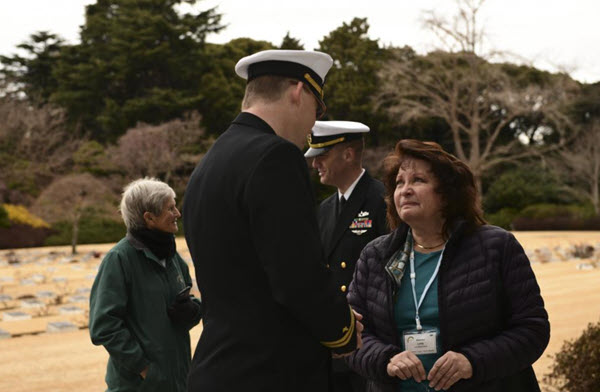
YOKOHAMA, Japan (February 14, 2023) In this photo by MC2 Ashley M.C. Estrella, U.S. Navy Chaplain Lt. Junior Grade Nicolas Tobin, assigned to Commander Fleet Activities Yokosuka, hands flowers to a service-veteran family member during a war memorial ceremony for the Japanese/POW(s) Friendship Program at Yokohama Commonwealth War Cemetery. The cemetery includes a large urn containing the ashes of 335 Sailors, Soldiers, and Airmen from the United States, the British Commonwealth, and the Kingdom of the Netherlands, who died as POWs in Japan. The ceremony is sponsored by the Japanese Ministry of Foreign Affairs and Commander, Navy Region Japan, bringing families of U.S. prisoners of war to Japan for a week-long reconciliation tour.
This special event with family members of former American Prisoners of War is at the invitation of the Japanese Ministry of Foreign Affairs as part of a cultural diplomacy program that started in 2010. The Japanese/POW Friendship Program seeks to promote a mutual understanding between the Japanese and American people by inviting former POWs, their family members, and caregivers to Japan as a gesture of reconciliation.
The Yokosuka base is located on 568 acres 43 miles south of Tokyo at the entrance of Tokyo Bay and is one of the most strategically important bases in the U.S. military. The base has a population of 24,500 military and civilian personnel making it the largest overseas U.S. Naval installation in the world.
- Details
- Hits: 3653
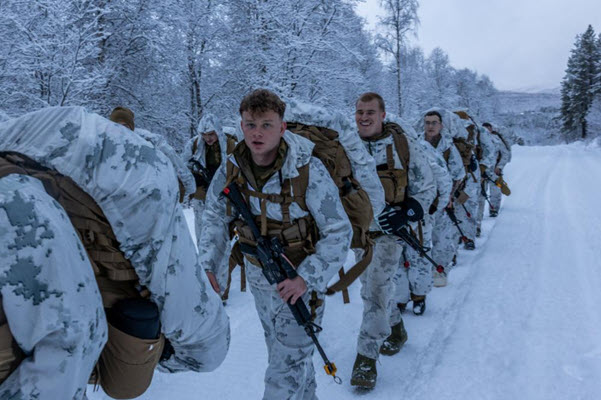
Setermoen, Norway, (January 29, 2023): In this photo by Sgt. Christian M. Garcia, U.S. Marines with Combat Logistics Battalion 2, Combat Logistics Regiment 2, 2nd Marine Logistics Group get a good look at the Norwegian countryside during a 5-kilometer hike during Marine Rotational Force- Europe 23. The American Marines train in various real-life exercises including mountain warfare and military to military engagements.
Marine Rotational Force-Europe 23 is an annual meeting of U.S. and Norwegian military units to confront Russian aggression on Europe’s northern flank. The American presence acknowledges Norway as a key strategic ally located on the Russian border and, hopefully, a new member of the NATO alliance.
For the Marines, Norway provides an ideal cold weather environment to test men and equipment to the maximum. With over 63,000 miles of coastline, Norway offers numerous options for realistic training for amphibious landings in an often frozen environment. Inland, Marines patrol with their Norwegian counterparts much as they would do should war break out.
The II Marine Expeditionary Force consists of four Expeditionary Units, each with their own aircraft wings and ground combat forces.
- Details
- Hits: 1336
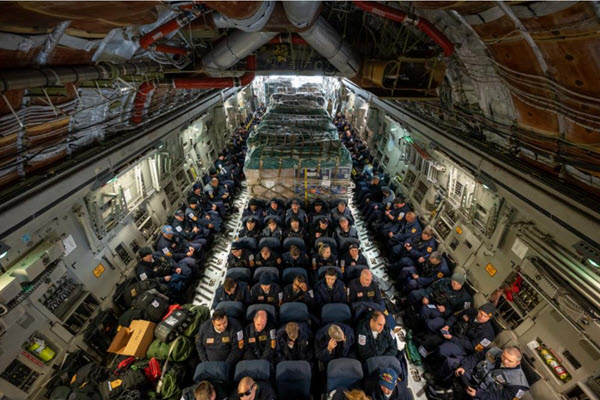
Dover Air Force Base, Delaware. (February 7, 2023): In this photo by Senior Airman Faith Barron, members of the Fairfax County Virginia Urban Search and Rescue Team board a C-7 Globemaster III headed to the earthquake zone as part of the U.S. Agency for International Development (USAID) emergency humanitarian response. The devastating impacts in Türkiye have stretched world resources to their limit as they struggle to cope with the worst earthquake to hit the region in nearly a century.
On February 6, a magnitude 7.8 earthquake struck central southern Türkiye, close to the Syrian border, followed by dozens of violent aftershocks. The earthquakes have resulted in over 45,000 deaths and has displaced millions.
USAID deployed a Disaster Assistance Response Team (DART) to lead the U.S. government’s response efforts to conduct disaster assessments, assist with search and rescue operations, and work with partners on the ground to save lives.
The Urban Search and Rescue team pictured above is a part of the Federal Emergency Management Agency’s urban search and rescue task force based in Fairfax County Virginia and sponsored by the Fairfax County Fire and Rescue Department.
Established in 1986, the task force is composed of over 200 specially trained career and volunteer fire and rescue personnel with expertise in the rescue of victims from collapsed structures following natural disasters or terrorist attacks.
- Details
- Hits: 1600
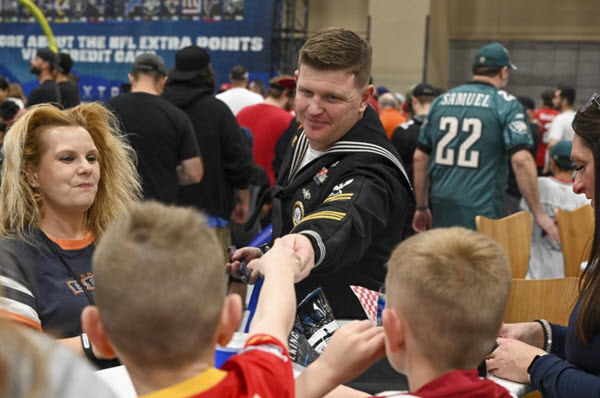
Phoenix, Arizona. (Feb. 5, 2023) – In this photo by Petty Officer 2nd Class Cody Anderson, Damage Controlman 1st Class Kreig Newton hands out recruiting aids to visitors at the Super Bowl 57 Fan Experience. Navy Recruiting Command consists of a command headquarters, two Navy Recruiting Regions, and 26 Navy Talent Acquisition Groups that serve 815 recruiting stations across the world. Their goal is to attract the highest quality candidates to assure the ongoing success of America’s Navy.
Since the Revolutionary War, Navy recruiters have fanned out across the country to recruit potential Sailors and Marines into military service. In 1775, the Navy created the Office of the Secretary of the Navy who assumed direct responsibility for recruiting.
In 1971, in response to the end of the military draft and an increased emphasis on Navy recruiting, the Secretary of the Navy established the Navy Recruiting Command to coordinate outreach to volunteers around the nation. With the ever-increasing technological sophistication Navy ships, submarines, and aircraft, the Navy recruiters must find, inspire, and recruit the best and brightest young men and women to serve in the diverse, high-tech Navy of the 21st Century.
Headquartered in Millington, Tennessee, the Navy Recruiting Command covers the entire United States with twenty-six (26) Navy Recruiting Districts commanded by two Navy Recruiting Regions. Today, nearly 6,000 active, reserve, and civilian contract employees staff more than 1,400 recruiting stations throughout the U.S., Guam, Puerto Rico, and Europe.
- Details
- Hits: 1891
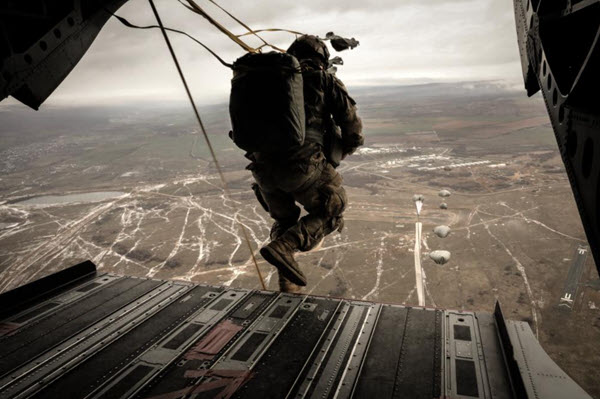
Novo Selo, Bulgaria. (February 4, 2023): In this photo by Pfc. Kyler Hembree, U.S. Army paratroopers assigned to the 54th Brigade Engineer Battalion, 173rd Airborne Brigade leap from a Chinook helicopter during training with America’s ally Bulgaria.
The 173rd Airborne Brigade is the U.S. Army's Contingency Response Force in Europe to provide rapidly deployable forces to the United States European, African, and Central Command areas of responsibility. Forward deployed across Italy and Germany, the brigade routinely trains alongside NATO allies and partners to build partnerships and strengthen the alliance.
The 173rd, nicknamed the “sky soldiers”, is an airborne infantry brigade combat team based in Vicenza, Italy and is responsible for conventional airborne strategic response for Europe. Activated in 1915, the unit saw service in WWII but is best known for its actions in the Vietnam War and the Battle of Dak To. The battle was one of the deadliest encounters with the North Vietnamese Army resulting in heavy casualties. Brigade members received over 7,700 decorations including more than 6,000 purple hearts.
America’s military alignment with Bulgaria dates to 1962 and has played a vital role for NATO ever since. In 2006, the U.S. and Bulgaria signed an agreement to allow a continuous rotation of up to 2500 troops to train with local and neighboring forces on tank warfare, reconnaissance, and how to defend against chemical and biological weapons.
The U.S. government has invested more than $80 million in upgrades and improvements at the Novo Selo site and, given the tensions with Moscow, plans to expand these facilities are likely to continue.