


- Details
- Hits: 2660
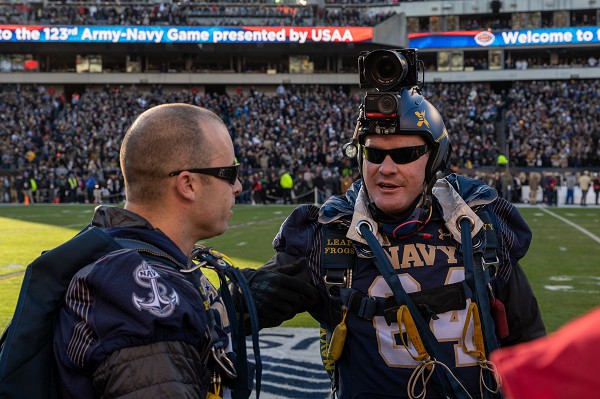
Philadelphia, Pennsylvania. (December 10, 2022): They leap from airplanes thousands of feet in the air and then perform a perfect landing in the middle of a football game as the crowd roars in appreciation. They are called “Leap Frogs”, and they are something special.
In the above photo by Petty Officer 2nd Class Austin Breum, Chief Aircrew Survival Equipment man Mike Halford and Special Warfare Operator 1st Class Cory Hager, members of the Navy parachute team the “Leap Frogs,” perform a demonstration at the 123rd Army-Navy Game held at Lincoln Financial Field in Philadelphia. The Leap Frogs are the official parachute demonstration team of the United States Navy and are part of the United States Naval Special Warfare Command. The Leap Frogs Navy Parachute Team are made up of active-duty Navy SEALs, Special Warfare Combatant-craft Crewmen (SWCC), Explosive Ordnance Disposal (EOD) Divers, and support personnel.
The Team began in 1969 when Navy SEALs and Underwater Demolition Team members volunteered to perform at weekend air shows. The team was officially commissioned “The Leap Frogs” in 1974 by the Chief of Naval Operations with the mission to demonstrate Navy excellence throughout the United States. Each team member has conducted real-world operations before volunteering to join this elite unit. Following a three-year commitment with the Navy Parachute Team, they will return to their operational units.
Today, the Leap Frogs continue to tour nationwide dazzling audiences with aerial demonstrations.
- Details
- Hits: 1288
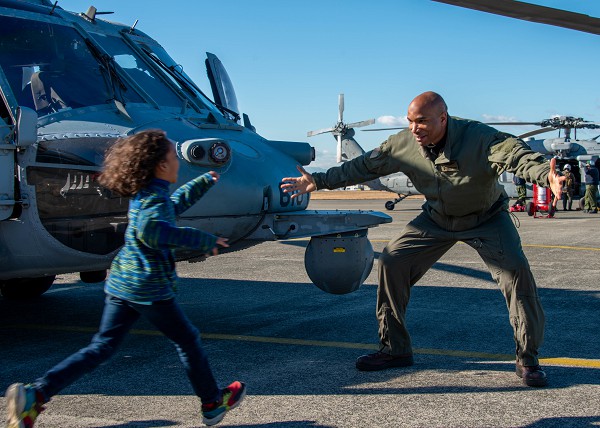
Atsugi, Japan (December 15, 2022): In this photo by MC2 Ange Oliver Clement, Chief Naval Air Crewman (Helicopter) Reginald Harvey from the "Golden Falcons" of Helicopter Sea Combat Squadron is greeted by his family at Naval Air Facility Atsugi, Japan. Crewman Harvey and the “Golden Falcons” completed a U.S. 7th Fleet deployment where they provided airpower in support of the USS Ronald Reagan Carrier Strike Group while it operated with allies and partners in support of a free and open Indo-Pacific.
The Golden Falcons are a helicopter anti-submarine squadron established in 1952 and they are the oldest active anti-sub squadron in the Navy. The unit has a complement of 190 enlisted and twenty-two officers who operate eight MH-60S Seahawk helicopters.
Read more: DADDY’S HOME! JOYOUS REUNIONS AS SQUADRON RETURNS
- Details
- Hits: 1611
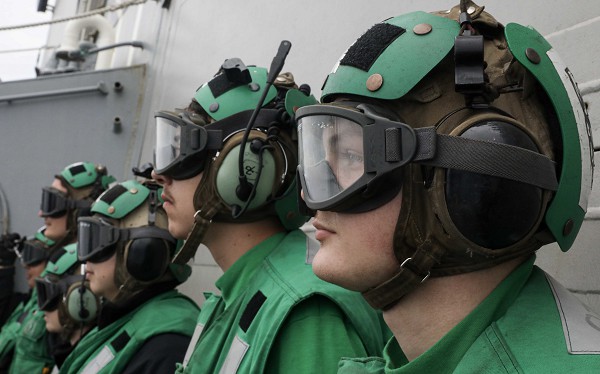
PHILIPPINE SEA (Jan. 17, 2023): In the photo by MC1 Greg Johnson, Sailors assigned to the Arleigh Burke-class guided-missile destroyer USS Rafael Peralta wait for an MH-60R Sea Hawk helicopter assigned to Helicopter Maritime Strike Squadron 51 to lift off from the ship’s flight deck. The Rafael Peralta is assigned to Commander, Task Force 71/Destroyer Squadron (DESRON) 15, the Navy’s largest forward-deployed DESRON and the U.S. 7th Fleet’s operating in the Philippine Sea.
Commissioned in 1991, the USS Rafael Peralta is the 65th Arleigh-Burke-class guided missile destroyer, one of the largest warship production run in Navy history. The Rafael Peralta’s mission is to guard the fleet from attack from enemy aircraft, surface ships, and submarines. A devastating weapon in its own right, the Rafael Peralta is packed with five types of weapon systems including the Tomahawk Cruise missile. The vessel’s undersea warfare capability includes the ability to launch four types of torpedoes, Defensively, the ship has a mix of defensive weapons including the deadly Phalanx anti-aircraft system that fires a shattering 50 rounds per second.
- Details
- Hits: 1241

U.S., January 31, 2023 - As reported last week, America has quite a few service members stationed in Jordan efforting matters in that general geographic area, including Syria. Good morale bolsters a good mission, and SupportOurTroops.org runs a substantial MWR (morale, well being, and recreation) program to help assure that. An interesting project has been underway for some time, and on the 17th it left port on a freighter headed their way. Its now on the high seas making its way over, which will take some weeks. This really is a hole in one for the troops, demonstrating Americans’ goodwill toward their military service members! Keep your eyes peeled for the series we're developing on it. All Together now!®
- Details
- Hits: 4367
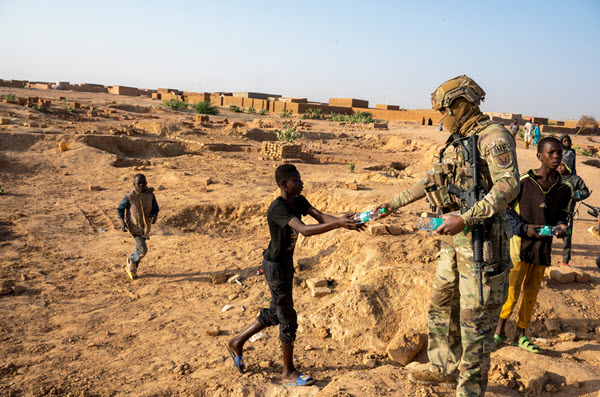
NIGERIEN AIR BASE 201, AGADEZ, Niger: (January 6, 2023): In this photo by Master Sergeant Michael Matkin, U.S. Air Force Senior Airman Lorenzo Bennette, assigned to the 409th Expeditionary Security Forces Squadron, hands a bottle of water to a local child near Air Base 201 in the African country of Niger. MSgt. Matkin is part of the base Quick Reaction Force (QRF), an elite unit comprised of Airmen from multiple squadrons trained in combat and evasion. These Airmen are highly skilled professionals who undergo special training to perform their duties in austere and potentially hostile environments.
Typically, a QRF is an armed military unit capable of rapidly responding to developing situations, to help allied units in need of such assistance. They must have the personnel and equipment ready to respond to any type of emergency within ten minutes or less.
The 409th Air Expeditionary Group was first activated in June 1943 during World War II. Today, the group operates intelligence, surveillance, and reconnaissance aircraft from unspecified locations in the horn of Africa.
- Details
- Hits: 1798
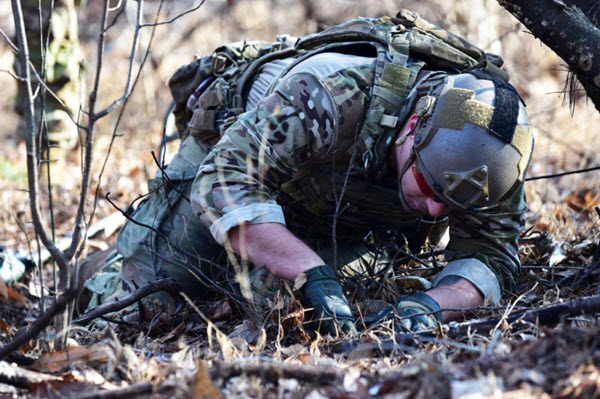
In this photo by Chin-U Pak, an Explosive Ordnance Technician assigned to the 2nd Infantry Division, carefully probes for land mines during a contest for Best EOD Team at Camp Humphreys, South Korea. One of the most hazardous jobs in the military, the EOD Specialist must have sure hands and nerves of steel to defuse live munitions in a combat zone. Explosive Ordnance Disposal technicians render safe all types of ordnance, including improvised, chemical, biological, and nuclear. They perform land and underwater location, identification, render-safe, and recovery of foreign and domestic ordnance.
These skills have saved thousands of American troops. Consider this, since 2001 the U.S. Military suffered 829 US military personnel killed in Afghanistan by IEDs – some 42% of all American forces killed there during the war. This experience has increased the need and urgency of training up new EOD Specialists.
So, what does it take to win such a glamorous job?
A candidate must pass 10 weeks basic training followed by 37 weeks advanced schooling in a wide range of topics including biology, chemistry, electronics, and the latest robotics. Army EOD Soldiers complete a seven-week preparatory course on Fort Lee, Virginia, followed by a 34-week course at the Naval EOD School on Eglin Air Force Base, Florida.